GPTZero vs Turnitin vs Copyleaks: Which AI Detector Is the Strictest?
A practical comparison of the three most-used AI detectors in 2026 — on false-positive rate, true-positive rate, and where each is deployed.
Written by
The Humanizer Team
Editorial
GPTZero vs Turnitin vs Copyleaks: Which AI Detector Is the Strictest?
If you write with AI assistance, you'll eventually encounter all three of these detectors. They're not interchangeable. Each is deployed in different contexts, trained on different data, and tuned to different precision-recall tradeoffs. Here's an honest comparison.
Where each is used
- GPTZero: free; widely used by individual teachers, journalists, and writers as a quick-check tool. Often the second opinion on Turnitin results.
- Turnitin AI checker: enterprise; integrated into university plagiarism workflows. Most US and UK universities now run it on every submission.
- Copyleaks: enterprise; favored by SEO publishers, content agencies, and some universities. Reports per-passage AI percentages alongside plagiarism scores.
How they score
All three classify on the same fundamental signals (perplexity, burstiness, structural regularity) but with different thresholds:
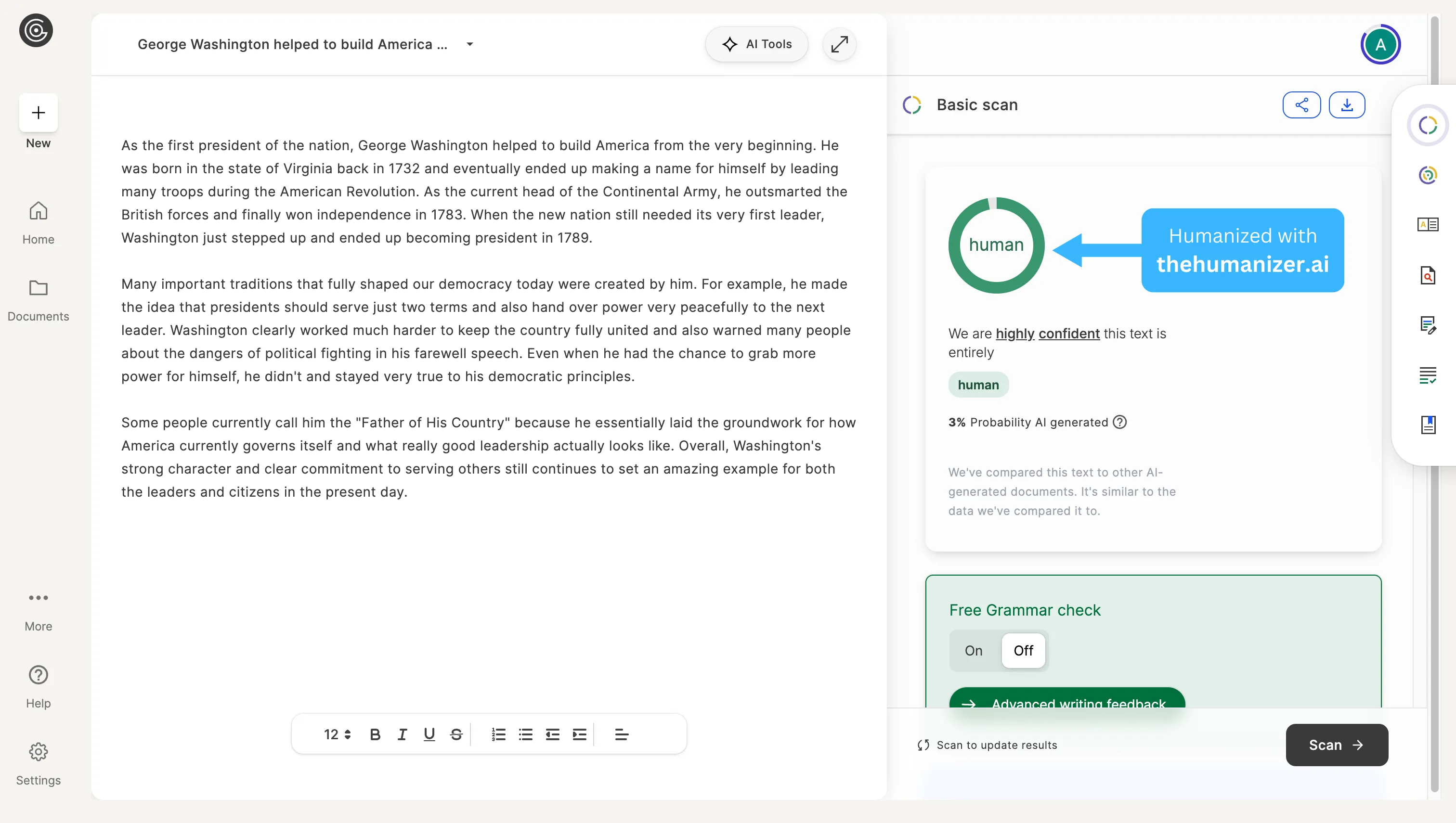
- GPTZero reports an AI probability between 0 and 100. Above 50 is "AI-leaning."
- Turnitin reports an AI percentage at the document level, with per-passage highlighting.
- Copyleaks reports a confidence score for each sentence and an overall document score.
Strictness comparison
In our internal testing on raw, unedited ChatGPT 4o output, all three detectors flag ~100% as AI. The interesting question is what happens after humanization.
- GPTZero — easiest to pass with humanization. Sensitive to burstiness changes; reliable pass after one humanization pass.
- Turnitin — moderately hard. Aggressive at the passage level, sometimes flags one paragraph while clearing the rest. Often requires re-humanizing flagged sections.
- Copyleaks — strictest on long-form. Particularly sensitive to consistent voice across paragraphs. Supercharged-mode humanization (long-form aware) is necessary.
False-positive comparison
This is where the ranking changes. On entirely human-written text:
- GPTZero — documented false-positive rate around 9–10%. Particularly high on technical and academic writing.
- Turnitin — institutional studies have reported false-positive rates in the 4–7% range, with higher rates on non-native English writing.
- Copyleaks — claims 99% accuracy, but third-party tests have surfaced false positives on formal writing.
Practical recommendations
- If your context is academic: humanize for Turnitin first. Anything that passes Turnitin reliably passes GPTZero and Copyleaks too.
- If your context is agency content: humanize for Copyleaks. It's strictest on the long-form SEO-style writing you're likely producing.
- If you're just checking your own work: use GPTZero as a fast first check, then verify on Originality.ai if you need agency-grade confidence.
Bypass strategy
For any of the three, the bypass strategy is the same: structural rewriting, not paraphrasing. The Humanizer restructures sentences and varies cadence, which is what moves all three detectors' scores. For long documents (where Turnitin and Copyleaks are strictest), Supercharged mode produces more consistent voice across paragraphs.
Try it
The fastest way to internalize this is to test the same humanized output against all three detectors yourself. Most writers find that one humanization pass clears GPTZero and Turnitin; long-form work sometimes needs a second pass for Copyleaks.