How GPTZero Detects AI Text — and How to Bypass It
A practical look at the perplexity-and-burstiness model behind GPTZero, and why structural rewriting beats paraphrasing.
Written by
The Humanizer Team
Editorial
How GPTZero Detects AI Text — and How to Bypass It
GPTZero is the AI detector most students and writers run into first. It's free, fast, and trusted by teachers as a quick second-opinion check. It's also more transparent than its competitors about how it works — which means we can analyze its weak spots in detail.
The two signals GPTZero measures
GPTZero scores text on two statistical properties:
Perplexity captures how surprised a small language model is by each next word in your text. Low perplexity means each word is highly predictable given the words before it — exactly what large language models produce by default. High perplexity means the writing makes unexpected word choices, which is characteristic of human prose.
Burstiness measures the variance in sentence length across your text. Humans write a mix of short and long sentences, often interleaving. LLMs produce sentences with a much tighter length distribution.
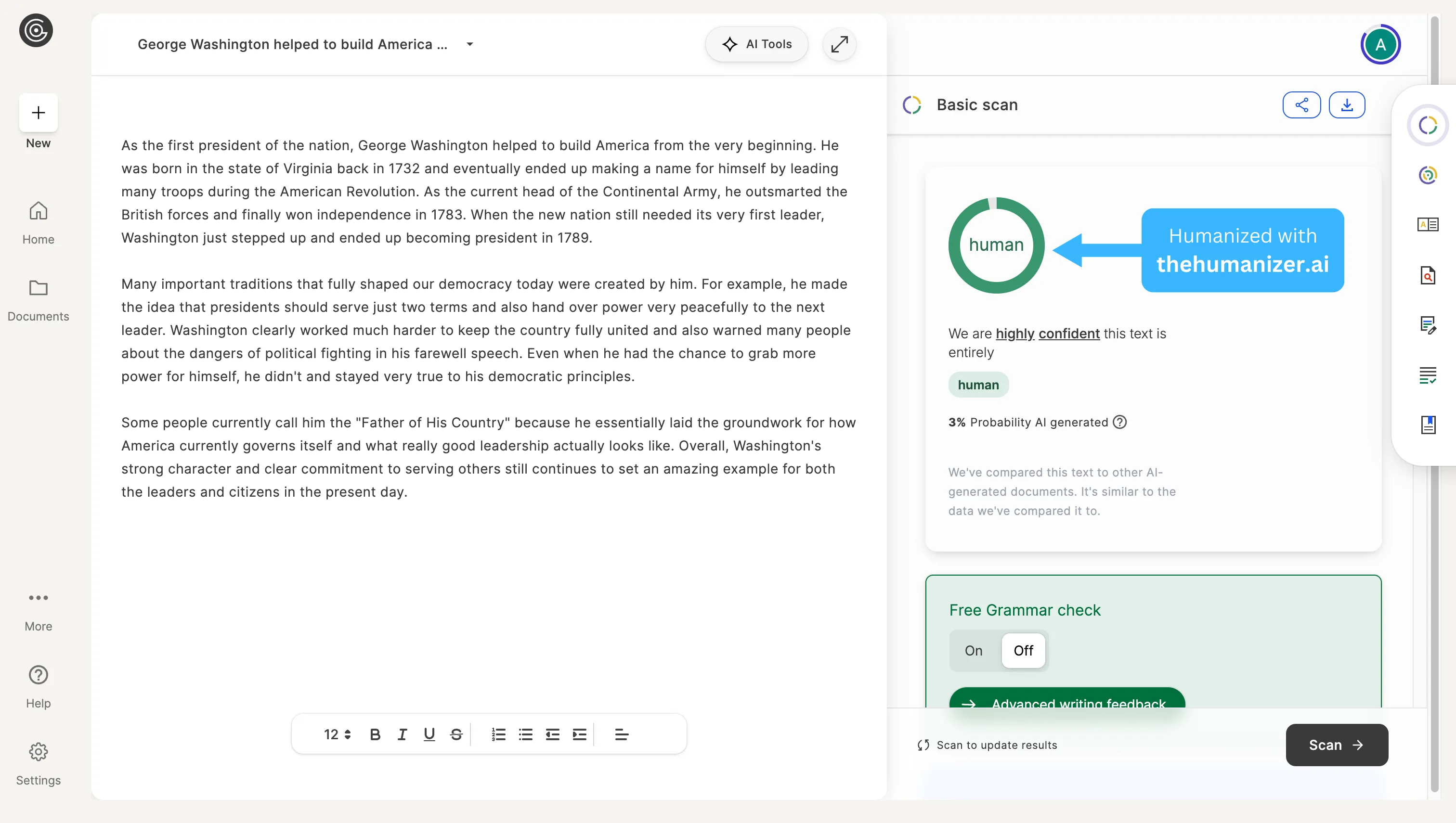
When perplexity is low and burstiness is low, GPTZero classifies the text as AI. When either is high, it leans toward "human."
Why simple paraphrasing fails on GPTZero
Most paraphrasers swap words but keep sentence-level structure intact. They might turn "ChatGPT writes consistent prose" into "ChatGPT produces uniform writing" — a different surface, but the same statistical fingerprint. Perplexity stays low because the synonym swap is itself predictable. Burstiness stays low because sentence length doesn't change.
This is why Quillbot's paraphraser often doesn't bypass GPTZero — and why dedicated humanizers like The Humanizer take a different approach.
What does pass GPTZero
Three changes consistently move text out of the AI bucket:
- Deliberate length variation. Mixing 8-word sentences with 30-word ones inside the same paragraph kills the burstiness signal.
- Unexpected word choices. Not synonyms — actually different lexical decisions. Where the LLM picked "furthermore," try cutting the transition entirely. Where it picked "navigate," try "deal with."
- Structural reordering. Move modifiers around. Lead with a subordinate clause. Break a long sentence into two.
A good humanizer does all three at once. The Humanizer specifically optimizes for these signals — that's why it reliably passes GPTZero where paraphrasers fail.
Practical tips
- Run a short test first. Generate 200 words in ChatGPT, paste it into The Humanizer, then check both versions on GPTZero. You'll see the score shift.
- For texts over 400 words, use Supercharged mode. It handles long-context rhythm better than the standard mode.
- If a section still flags, re-humanize just that section. The second pass usually clears it.
What GPTZero gets wrong
GPTZero has documented false-positive rates above 9% on human-written text — particularly on technical, formal, or non-native-English writing. If you've been falsely flagged on your own writing, the same humanization techniques can actually help: by adding burstiness and unexpected word choices, you read more "human" to the classifier.
Try it
The fastest way to understand any detector is to test against it. Open The Humanizer, paste a 200-word AI sample, humanize, and compare GPTZero scores before and after. It's the most informative five minutes you'll spend on this topic.