AI Humanizer vs Paraphraser: What's the Difference?
A paraphraser rewords text; an AI humanizer rewrites AI text so it reads, and scores, as human. Here's how they differ and when to use each one.
Key takeaways
- A paraphraser restates text in different words. An AI humanizer rewrites AI-generated text so its structure, rhythm and word predictability match human writing.
- Paraphrasing usually doesn't lower AI detection scores because it keeps the sentence structure and even rhythm that detectors measure.
- Use a paraphraser to reword, simplify or avoid repeating a source. Use an AI humanizer when AI-written text needs to sound natural and pass AI detectors.
- The two tools stack: paraphrase for phrasing you like, then humanize to remove the AI fingerprint.
In this guide
- What is a paraphraser?
- What is an AI humanizer?
- AI humanizer vs paraphraser: side-by-side
- Why doesn't paraphrasing lower AI detection scores?
- What does the difference look like in practice?
- When should you use a paraphraser?
- When should you use an AI humanizer?
- Can you use a paraphraser and a humanizer together?
- Is an AI humanizer just a fancy paraphraser?
- Does humanizing change the meaning of your text?
- Which one do you need? A quick checklist
- The bottom line
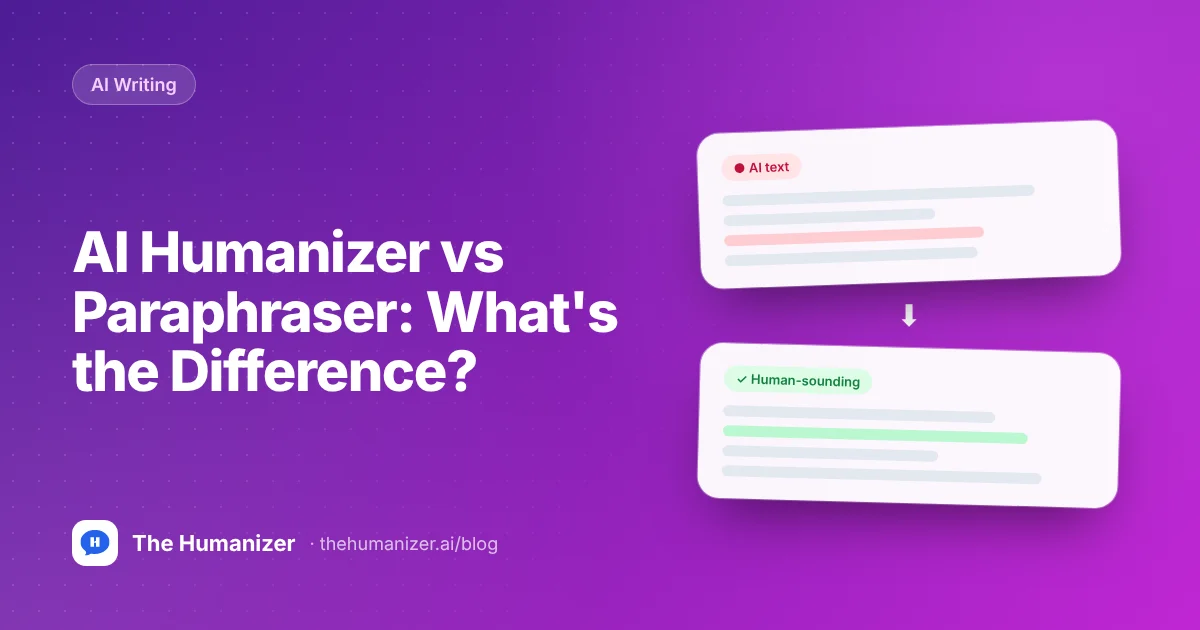
A paraphraser rewords text so it says the same thing in different words, mostly by swapping synonyms and reordering clauses. An AI humanizer rewrites AI-generated text so it reads like a person wrote it, changing sentence structure, rhythm and word predictability, which are the signals AI detectors actually measure.
So they overlap, but they're built for different jobs. If your goal is fresh wording, a paraphraser is fine. If your goal is AI text that sounds natural and passes detectors like GPTZero or Turnitin, you need a humanizer.
What is a paraphraser?
A paraphraser (or paraphrasing tool) takes a sentence or paragraph and restates it. Classic uses:
- Rewording a source so you don't repeat it word for word (with a citation, of course).
- Simplifying dense text.
- Changing tone from formal to casual, or the reverse.
- Getting unstuck on a sentence that won't come out right.
Most paraphrasers work close to the sentence level. Each input sentence maps to an output sentence with roughly the same structure and length, just different words. Quillbot is the best-known example.
What is an AI humanizer?
An AI humanizer is a rewriting tool built for one specific problem: text generated by ChatGPT, Claude, Gemini or another model reads as machine-made, both to people and to AI detectors.
A humanizer like The Humanizer rewrites at the level detectors look at. It varies sentence length, breaks up the predictable structures models produce, cuts stock phrases and makes word choices less statistically obvious, while keeping your original meaning. Think of it as an AI to human text converter rather than a thesaurus.
AI humanizer vs paraphraser: side-by-side
| Aspect | AI humanizer | Paraphraser |
|---|---|---|
| Main goal | Make AI text read and score as human | Restate text in different words |
| What it changes | Structure, rhythm, word predictability, stock phrases | Mostly vocabulary and clause order |
| Sentence structure | Rebuilt, lengths deliberately varied | Largely kept one-to-one |
| Effect on AI detector scores | Designed to lower them | Usually little change |
| Meaning | Preserved | Preserved |
| Best input | AI-generated drafts | Any text, including your own |
| Typical users | Students, marketers, bloggers, writers using AI drafts | Writers rewording sources or polishing phrasing |
Why doesn't paraphrasing lower AI detection scores?
Because detectors don't care much which synonym you used. They care about patterns that survive a synonym swap:
- Even rhythm. If the original had ten medium-length sentences, the paraphrase usually does too. Low burstiness stays low.
- Predictable structure. Topic sentence, three supporting points, summary. A paraphrase keeps the skeleton.
- Statistical predictability. Paraphrasers are often language models themselves, so they also pick likely words, and the output can be just as predictable as the input.
What does the difference look like in practice?
Here's one AI-written paragraph, followed by a typical paraphrase and a humanized version.
Original AI text: Time management is a crucial skill for students. It allows them to balance their academic responsibilities with their personal lives. By prioritizing tasks effectively, students can reduce stress and improve their overall performance.
Paraphrased: Managing time is an essential ability for students. It enables them to balance their school duties with their personal lives. By ranking tasks efficiently, students can lower stress and enhance their general performance.
Humanized: Most students don't run out of time; they run out of plan. Once you decide what actually has to get done this week, and what can wait, the stress drops and the grades usually follow.
Look at the paraphrase. Three sentences became three sentences of nearly identical length, in the same order, with "crucial" swapped for "essential" and "improve" swapped for "enhance." The skeleton is untouched, and so is most of what a detector measures.
The humanized version changes the skeleton. Sentence lengths differ, the structure is no longer topic sentence plus two supports, and the word choices are less predictable. The meaning is the same. The statistical profile isn't.
This is why Quillbot's standard paraphrasing modes often don't move an AI score much, and why Quillbot's own AI detector can still flag text its paraphraser rewrote. We go deeper on this in The Humanizer vs Quillbot and in our guide to bypassing Quillbot's AI detector. For the underlying mechanics, see how AI detectors work.
When should you use a paraphraser?
A paraphraser is the right tool when the problem is wording, not AI detection:
- You wrote the text yourself and want a cleaner or simpler version.
- You're summarizing a source in your own words and will cite it.
- You need a few alternative phrasings for a headline, subject line or product description.
- You want to shift the tone of a paragraph slightly.
When should you use an AI humanizer?
Use a humanizer when the text started with an AI model and needs to sound like a person wrote it:
- A ChatGPT or Claude draft that reads stiff and generic (see humanize ChatGPT text).
- Blog posts or client content that will be checked by Originality.ai or a similar tool.
- Essays drafted with AI help that need to read naturally. Check your institution's AI policy first, and only submit work you understand.
- Writing from non-native English speakers whose natural style gets falsely flagged. Our page for ESL writers covers this.
Can you use a paraphraser and a humanizer together?
Yes, and it's a sensible workflow when you like a paraphraser's phrasing:
- Draft with your AI model of choice.
- Paraphrase sections where you want different wording or a simpler tone.
- Humanize the full result with an AI humanizer to remove the AI fingerprint. For texts over 400 words, The Humanizer's Supercharged mode keeps long pieces consistent.
- Check the output with a free AI content detector, then read it through yourself.
Order matters. If you humanize first and paraphrase after, the paraphraser can reintroduce the even, predictable patterns you just removed.
Is an AI humanizer just a fancy paraphraser?
No, though both rewrite text. The difference is the target. A paraphraser optimizes for "different words, same meaning." A humanizer optimizes for "same meaning, human statistical profile." That second goal requires rebuilding sentences, not just relabeling them.
You can see the difference by running the same AI paragraph through both and comparing the results in a detector. The paraphrased version usually keeps the same rhythm; the humanized version doesn't.
Does humanizing change the meaning of your text?
It shouldn't, and with a good humanizer it doesn't. Facts, arguments, names and key terms stay the same; what changes is how the sentences are built. That's also true of a paraphraser, which is why both are safe for rewording.
Still, read the output before you use it. Any rewriting tool can occasionally soften a precise claim or shift emphasis, especially in technical or academic text. If you need a more formal register, The Humanizer's Academic mode keeps the tone closer to the original; Informal does the opposite, and Shorten trims length while keeping the point.
Which one do you need? A quick checklist
- Is the text AI-generated? If yes, start with a humanizer.
- Will an AI detector check it? If yes, you need a humanizer.
- Is it your own writing that just needs rewording? A paraphraser is enough.
- Do you mainly want grammar fixes? Use a grammar tool; neither is ideal.
If you're comparing humanizers specifically, our roundup of the best AI humanizers covers the main options and how they differ.
The bottom line
Paraphrasers change words. AI humanizers change the patterns that make text read as machine-written. If you're working from an AI draft and want it to sound natural and pass detectors, a paraphraser won't get you there on its own.
Try The Humanizer free: paste an AI paragraph, compare it with a paraphrased version, and see the difference for yourself. 350 words a month free, no credit card.
Frequently asked
Questions, answered
Written by
The Humanizer Team
Editorial