How Do AI Detectors Work? A Plain-English Guide (2026)
AI detectors estimate how predictable your writing is using trained classifiers, perplexity and burstiness. Here's how they work and why they get it wrong.
Key takeaways
- AI detectors don't know who wrote a text. They estimate how statistically predictable it is and compare that to patterns learned from human and AI writing.
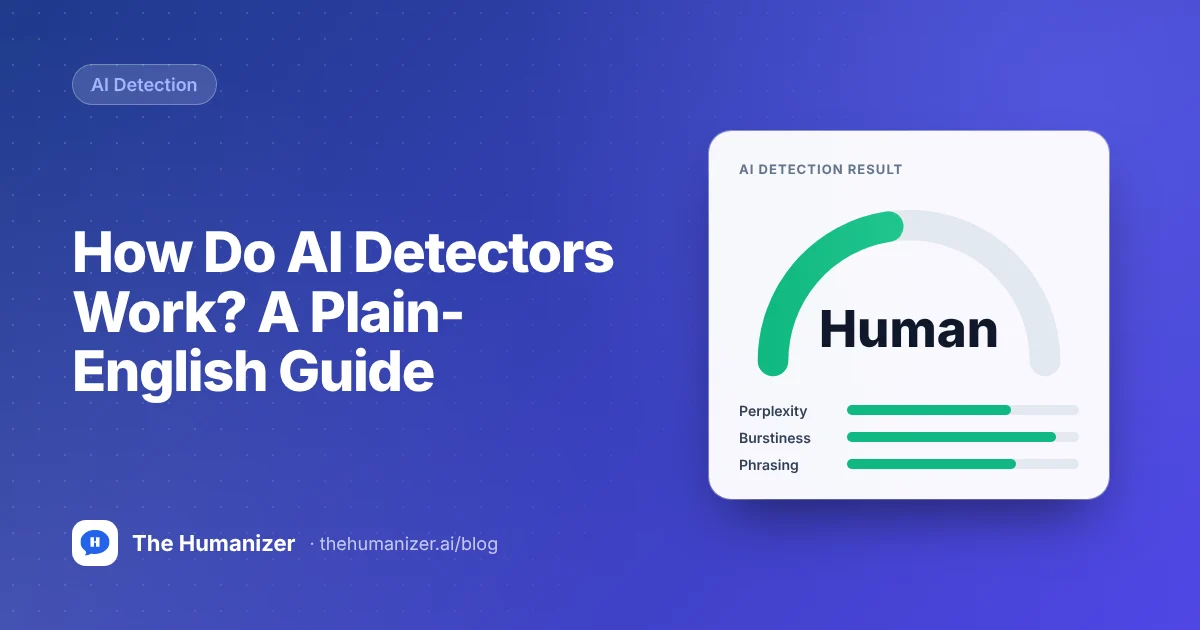
- The two signals behind most detectors are perplexity (how predictable each word is) and burstiness (how much that predictability varies between sentences).
- Every detector returns a probability, not proof. Short texts, formal writing and non-native English are the most common sources of false positives.
- Watermarking could make detection more reliable, but it only works if the AI provider embeds one and the checker has the key, so most detectors still rely on statistics.
- Rewriting at the structural level, not just swapping words, is what changes a detector's score.
In this guide
- What does an AI detector actually measure?
- How do classifier-based detectors work?
- Do AI detectors look for specific words?
- What about AI watermarking?
- Why are AI detectors not 100% accurate?
- Can AI detectors be wrong?
- How do the major detectors differ?
- What does this mean if you write with AI?
- How does an AI humanizer change what detectors see?
- The bottom line
AI detectors work by estimating how predictable a piece of writing is. Language models like ChatGPT choose words that are statistically likely, so their text tends to be smooth and even; detectors measure that predictability (perplexity) and how much it varies from sentence to sentence (burstiness), then feed those signals into a classifier trained on known human and AI writing. The result is a probability that the text is AI-generated, not proof of who wrote it.
That's the short answer. The rest of this guide explains each piece in plain English, where detectors break down, and what it means if you write with AI.
What does an AI detector actually measure?
An AI detector never sees your browser history or the chat you had with ChatGPT. All it has is the text you paste in. So it looks for statistical fingerprints that language models tend to leave behind.
Three ideas do most of the work.
Token probability
Language models write one token (roughly a word or word fragment) at a time. At each step they rank every possible next token by probability and usually pick one near the top.
A detector can run your text through its own language model and ask, at every position: how likely was this exact word? If almost every word was one of the model's top choices, the text looks machine-made.
Perplexity
Perplexity is the average of that surprise across a whole passage. Low perplexity means the text was easy to predict. High perplexity means it kept taking turns the model didn't expect.
Human writers make odd word choices, use slang, reference specific things only they know and occasionally write a clumsy sentence. All of that raises perplexity. Raw AI output tends to sit in a narrow, low band.
Burstiness
Burstiness measures variation. People write in bursts: a long, winding sentence, then a short one. Then a fragment. A model, left to its defaults, produces sentences of similar length and similar predictability, paragraph after paragraph.
A detector that sees low perplexity and low burstiness has the strongest case for "AI-generated."
| Signal | What it measures | Why AI text scores differently |
|---|---|---|
| Token probability | How likely each word was at its position | Models pick high-probability words by design |
| Perplexity | Average predictability across the text | AI text is consistently easy to predict |
| Burstiness | Variation in sentence length and predictability | AI keeps an even rhythm; people don't |
| Stylistic markers | Stock phrases, transitions, list structures | Models overuse certain words and patterns |
How do classifier-based detectors work?
Perplexity and burstiness are the intuition. Most commercial detectors go further and train a classifier: a machine-learning model shown huge numbers of labeled examples of human writing and AI writing until it learns to tell them apart.
Turnitin, Copyleaks, Originality.ai and the current version of GPTZero all use some form of trained classifier, often combined with probability-based features. The details are proprietary, but the workflow is similar:
- Split the document into sentences or chunks.
- Score each chunk for AI likelihood.
- Aggregate the chunk scores into a document-level percentage.
- Highlight the passages that pushed the score up.
This is why one stubborn paragraph can drag a whole essay's score up, and why detectors can disagree so sharply with each other. They were trained on different data, with different thresholds, for different customers.
Do AI detectors look for specific words?
Indirectly, yes. Models overuse certain words and constructions: "plays a crucial role," "it's important to note," "navigating the complexities," tidy three-item lists, and a summary sentence at the end of every paragraph.
Classifiers pick these up as features because they show up far more often in AI training examples than in human ones. They're not the whole story, but they move the needle. You can check a draft for these words with our free AI word checker, or get an overall pattern score from the free AI content detector.
What about AI watermarking?
Watermarking is a different approach. Instead of guessing after the fact, the AI provider nudges the model's word choices according to a secret key while it writes. The text reads normally, but anyone holding the key can run a statistical test and see the hidden pattern.
Google DeepMind has published a text watermarking method called SynthID Text, and other labs have researched similar ideas. So why isn't watermarking how detection works today?
- It needs the provider's cooperation. A watermark only exists if the company that built the model chose to add one.
- Open-source models don't have to use it. Anyone running their own model can skip it entirely.
- It needs the key. A watermark is useless to a third-party detector that can't check for it, which describes most tools teachers and editors use.
- Editing weakens it. Rewriting, paraphrasing or translating a text degrades the signal, especially in short passages.
For now, the detectors you're likely to run into (GPTZero, Turnitin, Copyleaks, ZeroGPT, Originality.ai) are statistical classifiers, not watermark readers.
Why are AI detectors not 100% accurate?
Because human and AI writing overlap. A careful human writer producing formal, well-structured prose can look statistically similar to a model. A model prompted to write casually can look human. No threshold separates the two cleanly.
A few public data points show how hard the problem is:
- OpenAI shut down its own AI text classifier in July 2023, citing its low rate of accuracy. In OpenAI's own evaluation it correctly identified only 26% of AI-written text.
- A 2023 Stanford study (Liang et al.) found that GPT detectors misclassified more than half of TOEFL essays written by non-native English speakers as AI-generated. Simpler vocabulary and sentence structures read as "predictable."
- Turnitin says its document-level false positive rate is under 1% for documents with more than 20% AI writing. That's a specific, limited claim, and it still means false flags happen at scale.
Short texts are the hardest. With only a few sentences there's too little signal, which is why most detectors ask for a minimum length.
Can AI detectors be wrong?
Yes, in both directions. A false positive flags human writing as AI. A false negative lets AI writing through. Detectors are tuned to balance the two, and different vendors make different trade-offs.
The people most exposed to false positives are writers whose style is naturally even: technical writers, non-native English speakers, students taught to follow strict essay templates. We cover this in depth in why AI detectors have false positives and is GPTZero accurate?. If it's already happened to you, read what to do if you're falsely accused of using AI.
How do the major detectors differ?
They share the same basic idea but are built for different audiences.
| Detector | Typical users | What stands out |
|---|---|---|
| GPTZero | Teachers, students | Popularized perplexity and burstiness; sentence highlighting |
| Turnitin | Schools and universities | Built into assignment submission; reports go to instructors |
| Copyleaks | Schools and businesses | Sentence-level results, multiple languages |
| ZeroGPT | General public | Free web checker with a single percentage |
| Originality.ai | Publishers, SEO teams | Paid per scan, aimed at content workflows |
For a head-to-head on strictness, see GPTZero vs Turnitin vs Copyleaks.
What does this mean if you write with AI?
Detectors score patterns, not intent. A draft you outlined, argued and fact-checked yourself can still be flagged if long stretches of it came straight out of a model. Practically, that means:
- Raw AI output will usually be flagged. Unedited ChatGPT, Claude or Gemini text sits right in the range detectors were trained on.
- Swapping synonyms isn't enough. It changes surface words but leaves sentence structure and rhythm intact, which is what classifiers lean on.
- Structural rewriting works. Varying sentence length, breaking predictable structures and changing word choice at the level detectors measure is what moves a score.
- Check before you submit. Run your final text through a detector so you aren't surprised later.
How does an AI humanizer change what detectors see?
An AI humanizer like The Humanizer rewrites AI-generated text so its statistical profile looks human: more variation in sentence length, less predictable word choices, fewer stock phrases, while keeping your meaning intact. It targets the same signals described above instead of just paraphrasing.
That's why it's designed to pass detectors like GPTZero, Turnitin and Copyleaks, and why re-humanizing a borderline result usually pushes it further into the human range. Results vary by text and detector, so it's worth checking the output before you use it. For a detector-by-detector overview, start with our guide to bypassing AI detection.
If you're writing for school, know your institution's AI policy first and only submit work you understand and stand behind.
The bottom line
AI detectors are probability machines. They measure how predictable your writing is, compare it to what they learned from human and AI text, and give you an estimate, sometimes a wrong one. Understanding the signals helps you edit smarter, and a good humanizer handles the heavy lifting in seconds.
Want to see it on your own text? Try The Humanizer free: 350 words a month, no credit card required.
Frequently asked
Questions, answered
Written by
The Humanizer Team
Editorial