Turnitin AI Score Explained: What Your Percentage Means (2026)
Your Turnitin AI score is the share of your writing Turnitin's model flags as AI-generated. Learn how to read it, what counts as high, and what to do next.
Key takeaways
- Your Turnitin AI score is the share of qualifying prose Turnitin's model flags as AI-generated. It is not a plagiarism score and not proof of cheating.
- Scores between 1% and 19% show as an asterisk because, according to Turnitin, low scores carry a higher risk of false positives.
- Students usually can't see the AI score. Instructors and administrators can.
- Turnitin says the AI score shouldn't be the sole basis for an academic misconduct decision.
- If you wrote the work yourself, your version history and drafts are your strongest evidence.
In this guide
- What does the Turnitin AI score actually measure?
- Who can see your Turnitin AI score?
- How to read your Turnitin AI percentage
- How accurate is Turnitin's AI detector?
- What counts as a "high" Turnitin AI score?
- Why your score might be high even if you wrote it yourself
- What to do if your Turnitin AI score is high
- How to check your work before Turnitin does
- Can Turnitin detect humanized or edited AI text?
- The bottom line
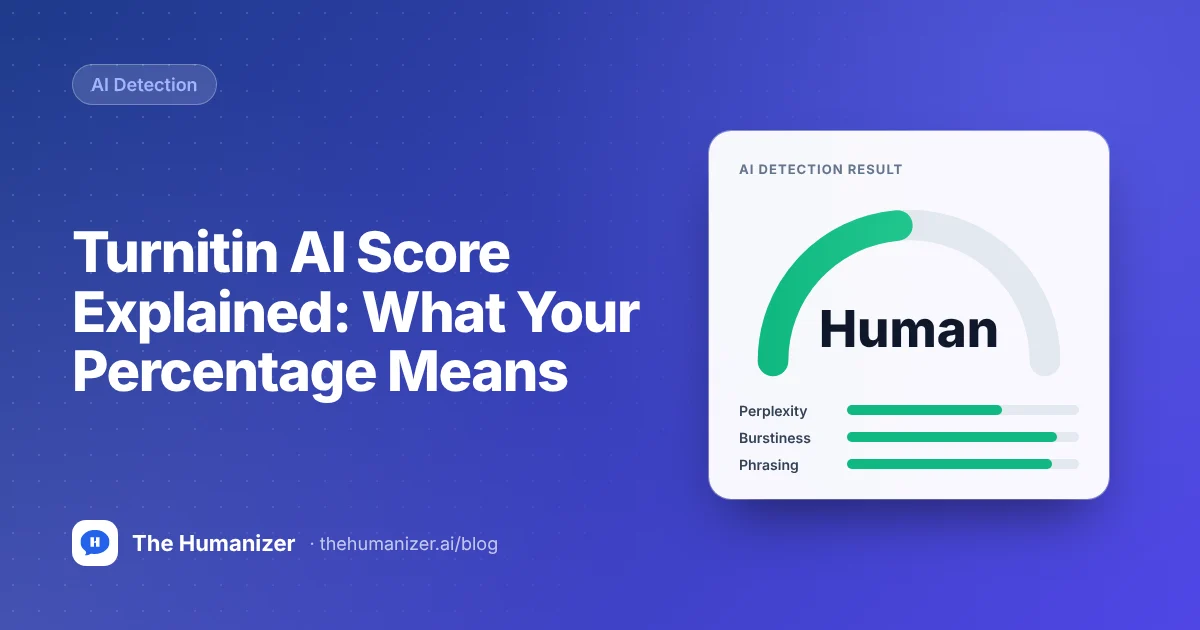
Your Turnitin AI score is the percentage of qualifying prose in your submission that Turnitin's model believes was generated by AI. It is not a plagiarism score, and it is not a probability that you cheated. A 30% score means Turnitin flagged roughly 30% of the sentences it analyzed, nothing more.
That distinction matters, because the number on an instructor's screen often gets read as a verdict. Below is how the score is calculated, who sees it, what the ranges mean, and what to do if yours came back higher than expected.
What does the Turnitin AI score actually measure?
Turnitin breaks your document into overlapping segments of text and runs each one through a classifier trained on human writing and on output from popular large language models. Sentences that cross Turnitin's internal threshold get highlighted. The overall percentage is the share of qualifying text that was flagged.
A few details shape that number:
- Only "qualifying text" counts. Turnitin focuses on long-form prose, meaning sentences in paragraphs. Bullet lists, tables, code, poetry, and short fragments are generally left out of the calculation.
- There's a minimum length. According to Turnitin's documentation, a submission needs a few hundred words of prose before the AI report will generate at all. Short responses often come back with no score.
- It's sentence-level, rolled up. A 40% score doesn't mean the whole essay is "40% AI-ish." It means specific sentences were flagged, and together they make up about 40% of the analyzed text.
Is the AI score the same as the similarity score?
No. The similarity score compares your text against a database of web pages, publications, and past submissions to find matching passages. The AI score looks for statistical patterns typical of machine-generated writing. You can have 0% similarity and a high AI score, or the reverse.
| Similarity score | AI writing score | |
|---|---|---|
| What it checks | Matches with existing sources | Patterns typical of AI-generated text |
| How it works | Database comparison | Machine-learning classifier |
| What gets highlighted | Matching passages, with source links | Sentences the model thinks are AI-written |
| Typical visibility | Often shared with students | Usually instructor-only |
Who can see your Turnitin AI score?
In most setups, only your instructor and administrators can see the AI writing report. Students typically see their similarity report (if the instructor allows it) but not the AI score. Your institution controls these settings, so some schools hide the AI indicator entirely while others enable it for every assignment.
This is why so many students first hear about their AI score in an email from a professor. If you want to know where you stand before submitting, check your draft with an independent tool such as our free AI detector.
How to read your Turnitin AI percentage
There's no official pass/fail line, but this is how the ranges are usually interpreted:
| Score shown | What it means | How instructors tend to treat it |
|---|---|---|
| 0% | No qualifying text was flagged | No concern |
| * (asterisk) | A low score between 1% and 19% | Usually not acted on |
| 20–40% | Some sections flagged | A reason to look closer, not proof |
| 40–80% | Large portions flagged | Often triggers a conversation |
| 80–100% | Most of the text flagged | Treated as a strong signal |
Why does my Turnitin AI score show an asterisk?
According to Turnitin, in 2024 it stopped displaying an exact percentage for scores between 1% and 19%, and an asterisk appears instead. Turnitin made the change because low scores carry a higher chance of false positives, and a specific number like "12%" was being treated as evidence when it shouldn't have been.
What do the two highlight colors mean?
Turnitin's report separates two categories. One color (cyan) marks text it believes is AI-generated. A second color (purple) marks text it believes was AI-generated and then run through an AI paraphrasing tool or word spinner.
That second category exists to catch people who try to disguise ChatGPT output with basic rewording tools. It's also why a paraphraser and a humanizer are not the same thing. We explain the difference in AI humanizer vs paraphraser.
How accurate is Turnitin's AI detector?
Turnitin says its document-level false positive rate is under 1% for documents with more than 20% AI writing. That's a narrow claim. It applies to documents above that threshold, and Turnitin has acknowledged that individual sentences are misflagged more often than whole documents are.
Outside research paints a less tidy picture of AI detection in general:
- OpenAI shut down its own AI text classifier in July 2023 because of low accuracy. In OpenAI's evaluation, it correctly identified only 26% of AI-written text.
- A 2023 Stanford study (Liang et al.) found that popular GPT detectors flagged more than half of TOEFL essays written by non-native English speakers as AI-generated.
Turnitin's own guidance tells instructors that the AI score should not be used as the sole basis for academic misconduct decisions. It's meant to start a conversation. We cover the wider problem in why AI detectors have false positives.
What counts as a "high" Turnitin AI score?
Each institution decides. Many instructors treat anything at 20% or above as worth a closer look, mostly because that's where Turnitin starts showing a number. Others only act on scores well above 50%. Some departments have switched the AI indicator off entirely.
In practice, context decides what "high" means:
- A flagged introduction and conclusion in an otherwise personal essay looks very different from a fully flagged lab report.
- A score that's out of line with your earlier submissions draws more attention than a consistent one.
- A flag on generic background sections matters less than a flag on your core argument.
Why your score might be high even if you wrote it yourself
Detectors look for predictable language, and plenty of honest writing is predictable:
- Formulaic assignments. Lab reports, literature reviews, and five-paragraph essays follow templates, and templates produce uniform sentences.
- Heavy grammar tools. Accepting dozens of rewrite suggestions from an AI-powered editor can smooth your writing into something that looks machine-made.
- Translation. Drafting in another language and translating into English often produces flat, regular phrasing.
- A very formal tone. Careful academic prose has low variation, which is exactly what classifiers associate with AI.
- Writing in a second language. Non-native writers tend to rely on common words and safe sentence structures. Our page for ESL writers explains why this raises the risk of false flags.
What to do if your Turnitin AI score is high
Your next step depends on how you wrote the paper.
If you wrote it yourself
- Don't panic, and don't admit to something you didn't do.
- Ask your instructor which passages were flagged and what the score was.
- Pull together your version history from Google Docs or Word, plus outlines, notes, and sources.
- Offer to walk through your argument in person.
We've written a full, step-by-step plan for this situation: what to do if you're falsely accused of using AI.
If you used AI as a drafting aid
First, check your course policy. Many institutions now allow AI for brainstorming, outlining, or grammar help, as long as you disclose it. If your use was within the rules, say so plainly.
If you're still drafting, the fix is to make the writing genuinely yours before you submit:
- Rewrite flagged sentences in your own words and voice.
- Add specifics only you would know: lecture points, assigned readings, your own examples.
- Verify every citation. AI tools still invent sources.
- Run stiff passages through an AI humanizer to restore natural rhythm and variation. The Humanizer's Academic mode is built for essays, and our guide to humanizing an AI essay walks through the process.
How to check your work before Turnitin does
Because students rarely see their own AI score, the safest move is to check the draft yourself first:
- Run a detector. Paste your draft into our free AI detector to spot sections that read as machine-written. Test whole sections rather than single sentences.
- Look for AI vocabulary. The AI word checker flags words and phrases that show up far more often in AI text, such as "plays a pivotal role" or "a testament to."
- Vary your sentences. Mix short and long sentences, and break up paragraphs that all follow the same shape.
- Read it out loud. Anything you would never actually say is a candidate for rewriting.
- Humanize what's left. For AI-assisted sections, The Humanizer rewrites at the sentence-structure level, which is what Turnitin's classifier actually measures. See how it works on our Turnitin page.
Can Turnitin detect humanized or edited AI text?
Sometimes. Turnitin keeps retraining its model, and it added the AI-paraphrasing category specifically to catch lightly disguised output. Simple synonym swaps rarely work anymore.
Deeper rewrites that change sentence structure, rhythm, and word choice are much harder for any classifier to flag. Text you've reworked with your own ideas, examples, and sources is harder still, and it's better writing. For the bigger picture, read can Turnitin really detect ChatGPT?
The bottom line
A Turnitin AI score measures patterns. It doesn't prove misconduct. Read the percentage as "share of sentences flagged," know that low scores now show as an asterisk, and remember that Turnitin itself says the number shouldn't decide a case on its own.
If you're working from an AI-assisted draft, make it your own and check it before you submit. You can try The Humanizer with 350 free words a month, no credit card required.
Frequently asked
Questions, answered
Written by
The Humanizer Team
Editorial