Is GPTZero Accurate? Strengths, Limits & False Positives (2026)
GPTZero is reliable on raw, unedited AI text but far less certain on short, formal, edited, or non-native writing. Here's how to read its results fairly.
Key takeaways
- GPTZero is most accurate on raw, unedited AI text in longer passages.
- It struggles with short texts, formal or technical writing, non-native English, and edited or mixed text.
- A GPTZero probability is the model's confidence, not the percentage of the text written by AI.
- Detectors often disagree, so a single GPTZero score should never be treated as proof.
- To check your writing fairly, test full sections with more than one detector.
In this guide
- How does GPTZero decide if text is AI?
- Where GPTZero is accurate
- Where GPTZero struggles
- How to read GPTZero's results
- Why one GPTZero score isn't proof
- GPTZero compared with other detectors
- How to check your own text fairly
- What to do if GPTZero flags your writing
- Should teachers and editors rely on GPTZero?
- The bottom line
GPTZero is fairly accurate on raw, unedited AI text, especially in longer passages. It is much less reliable on short texts, formal or technical writing, work by non-native English speakers, and text that mixes human and AI writing or has been edited. Treat a GPTZero result as a signal worth investigating, not as proof of who wrote something.
Below: how GPTZero makes its call, where it does well, where it struggles, and how to read its results fairly.
How does GPTZero decide if text is AI?
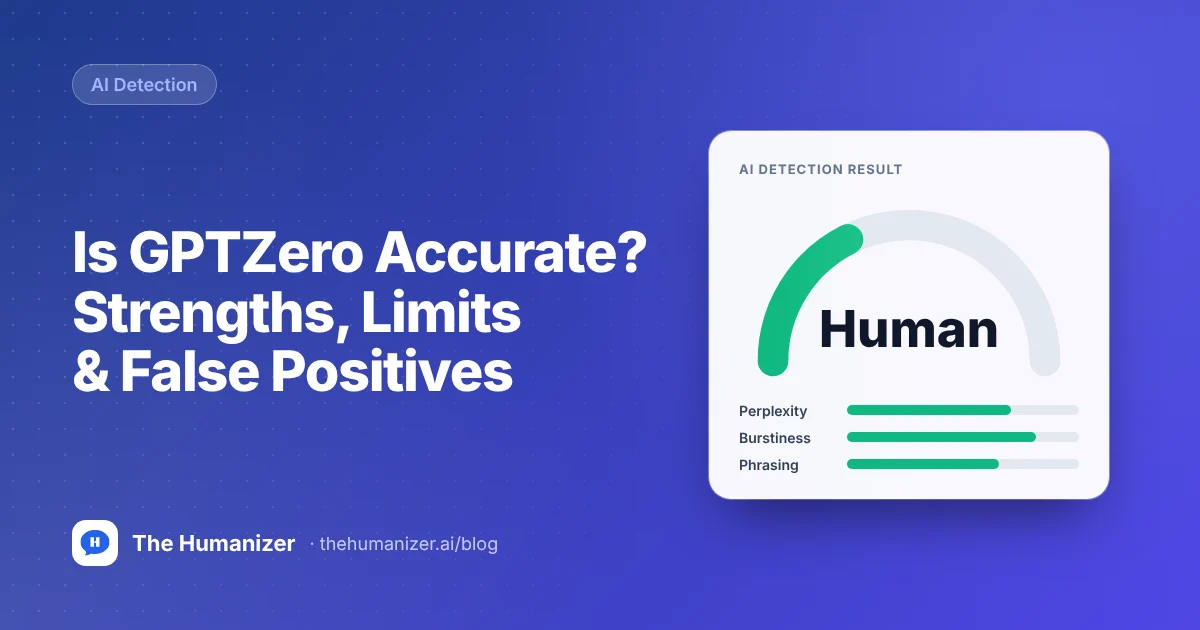
GPTZero started out with two statistical measures, and they're still central to how it works:
- Perplexity measures how predictable each word is to a language model. AI text tends to pick the most likely next word, so its perplexity is low.
- Burstiness measures how much sentence length and structure vary. Human writing swings between short and long sentences. AI writing tends to keep a steady rhythm.
Since launch, GPTZero has layered a deep-learning classifier on top, trained on large sets of human-written and AI-generated text. The output is an overall classification for the document plus sentence-level highlighting of passages it considers likely AI. We break down the mechanics in how GPTZero detects AI, and the broader picture in how AI detectors work.
Where GPTZero is accurate
GPTZero performs best when the input looks like the data it was trained on:
- Raw output from ChatGPT, Claude, or Gemini pasted in without edits
- Longer passages of several paragraphs, which give the model enough signal
- Single-author text, written entirely by a person or entirely by AI
- Generic topics, where AI output falls into familiar patterns
GPTZero reports high accuracy on its own benchmarks, and on clean, unedited AI text it usually lives up to that. If someone pastes a full ChatGPT answer straight into an assignment, GPTZero will usually catch it.
The trouble starts when real-world writing gets messier. Very little text in the wild is purely one thing: students edit AI drafts, writers use grammar tools, and professionals reuse templates. Every one of those habits moves text away from the clean examples a classifier learns from.
Where GPTZero struggles
| Situation | Why it's hard | What you might see |
|---|---|---|
| Short texts | Too few sentences to measure patterns reliably | Unstable results that change with small edits |
| Formal or technical writing | Precise, conventional language is naturally predictable | Human work flagged as AI |
| Non-native English | Writers favor common words and safe structures | More false positives |
| Edited AI text | Human edits break up AI patterns unevenly | Mixed or uncertain classifications |
| Mixed authorship | Part human, part AI in one document | Partial highlighting and hard-to-read scores |
| Templated content | Lab reports, legal boilerplate, product descriptions | Flags on text that had to be formulaic |
The non-native writer problem is well documented. A 2023 Stanford study (Liang et al.) found that GPT detectors misclassified more than half of TOEFL essays written by non-native English speakers as AI-generated. GPTZero reports high accuracy on its own benchmarks, but independent researchers and educators have repeatedly found false positives on human writing, across detectors and including GPTZero. We cover the causes in why AI detectors have false positives.
How to read GPTZero's results
A GPTZero report usually gives you three kinds of information: an overall classification (labels along the lines of human, AI, or mixed), probability figures, and highlighted sentences. Each needs a little care.
Probability is not a percentage of the text
This is the most common misreading. If GPTZero says a document is "85% likely AI," that's the model's confidence in its classification. It does not mean 85% of the words were written by AI.
Mixed results are common and meaningful
A mixed result means GPTZero thinks some parts look human and others look like AI. That can reflect genuine mixed authorship. It can also mean nothing more than a formal introduction attached to a more personal body.
Highlighted sentences show where, not why
Highlights point to the sentences that pushed the score up. They're useful for revising, but a highlighted sentence isn't proven AI. It's just statistically typical.
Confidence levels matter
GPTZero often labels how confident it is in a result. A low-confidence AI classification deserves much less weight than a high-confidence one.
Why one GPTZero score isn't proof
Even setting false positives aside, a single score has limits:
- Detectors disagree. The same text can score human on one tool and AI on another. Our comparison of GPTZero, Turnitin, and Copyleaks shows how differently they behave.
- Scores move with small edits. Changing a handful of sentences can flip a borderline result.
- Models update. GPTZero retrains regularly, so last month's score may not match today's.
- The text carries no record of who wrote it. No detector can see your drafts, your notes, or your thinking.
That's why most academic policies treat these tools as one input among several. If you've been flagged on work you wrote yourself, read our guide on what to do if you're falsely accused of using AI.
GPTZero compared with other detectors
| Detector | Common users | Who sees results | Notes |
|---|---|---|---|
| GPTZero | Teachers, students, editors | Whoever runs the check | Free tier; sentence highlighting |
| Turnitin | Universities and schools | Usually instructors only | Built into submission systems |
| Copyleaks | Schools and businesses | Account holders | Also offers plagiarism checking |
| ZeroGPT | Content writers, students | Whoever runs the check | Free; percentage-style score |
Each tool is trained differently and sets its own thresholds, which is why the same paragraph can land in different buckets on each one.
How to check your own text fairly
If you want an honest read on how your writing looks to GPTZero and similar tools:
- Test full sections, not single sentences. Short snippets produce noisy results.
- Use more than one detector. Compare GPTZero with our free AI detector and note where they agree.
- Read the highlights. Look for patterns: repeated sentence openers, uniform paragraph lengths, stock transitions.
- Fix the patterns, not just the words. Vary sentence length, cut filler phrases, and add concrete specifics.
If you're working with an AI-assisted draft, a dedicated humanizer changes the patterns GPTZero measures instead of just swapping synonyms. The Humanizer rewrites sentence structure and rhythm while keeping your meaning. See how it handles GPTZero specifically.
What to do if GPTZero flags your writing
If you wrote it yourself, gather your version history and drafts, and ask whoever flagged it which passages concerned them. A record of your process is far stronger evidence than any detector score.
If you used AI to help draft it, check whether that was permitted, then revise. Rewrite flagged sentences in your own voice, add details only you would know, and smooth robotic passages with an AI humanizer. Re-check before you submit or publish, and remember that results vary by text and by detector.
Should teachers and editors rely on GPTZero?
As a screening tool, it can be useful. It's fast, it highlights specific sentences, and it does well on unedited AI output. As a deciding tool, it falls short, for all the reasons above.
A fair process uses a GPTZero result as the start of a conversation. Look at the highlighted passages, compare the piece with the writer's earlier work, ask for drafts or version history, and talk to the writer. If several of those point the same way, you have something. If the only evidence is a probability figure, you don't.
For writers, the practical takeaway is the same: don't panic over one score, and don't treat a clean score as permission to skip your own review.
The bottom line
Is GPTZero accurate? On raw AI text, mostly yes. On short, formal, edited, or non-native writing, much less so. Its results work best as a prompt to look closer, never as a final answer.
If your AI-assisted drafts keep getting flagged, The Humanizer is built to turn them into natural, human-sounding writing. You can try it free with 350 words a month, no credit card required.
Frequently asked
Questions, answered
Written by
The Humanizer Team
Editorial