Can you use AI on a college application essay?
It depends on where you're applying, so read each school's instructions first. Two examples show the range:
- Common App's fraud policy covers "intentionally misrepresenting as one's own original work" the "substantive content or output of an artificial intelligence platform, technology, or algorithm." You agree to it when you submit.
- Brown University says applicants can't use AI for their application content, and may use it only to help with spelling and grammar review.
Other schools publish their own rules, and policies change from year to year. If a school limits AI to spelling and grammar, don't run your essay for that school through a humanizer. Where AI help is allowed, use it to polish writing that's already yours. Our guide to academic AI policies explains how these rules are usually written.
When does a humanizer make sense for a college essay?
There are a few honest reasons to use one:
- You wrote the essay yourself and a detector flagged it. Careful, polished writing can look regular to a detector. Our guide on why your writing gets flagged as AI explains how that happens.
- English isn't your first language. The ideas are yours, but the phrasing is stiffer than you'd like. See our guide for ESL writers.
- You used AI for feedback or edits your schools allow, and some sentences now sound generic rather than like you.
What it isn't for: generating an essay with AI and running it through a humanizer to hide that. Admissions readers are looking for you in the essay. A story that didn't happen to you can't do that job, however it's phrased.
How do you make an AI-assisted essay sound like you?
The Humanizer fixes rhythm and phrasing. The rest is on you, and it matters more:
| Generic line | What to do instead |
|---|---|
| "This experience taught me the value of hard work." | Show the moment: the shift, the mistake, what you did next |
| "I have always been passionate about science." | Name the experiment, book, or question that started it |
| "I learned that failure is a stepping stone to success." | Say what you did differently the next time |
| "I want to make a positive impact on my community." | Describe one specific thing you've already done |
Read your draft out loud. Anything you wouldn't say to a teacher who knows you should go. Our guide to humanizing AI text by hand has more edits like these, and the sentence length checker shows where your sentences have all drifted to the same length.
How do you polish your essay with The Humanizer?
- Start from your own draft, with your story, your details, and your structure.
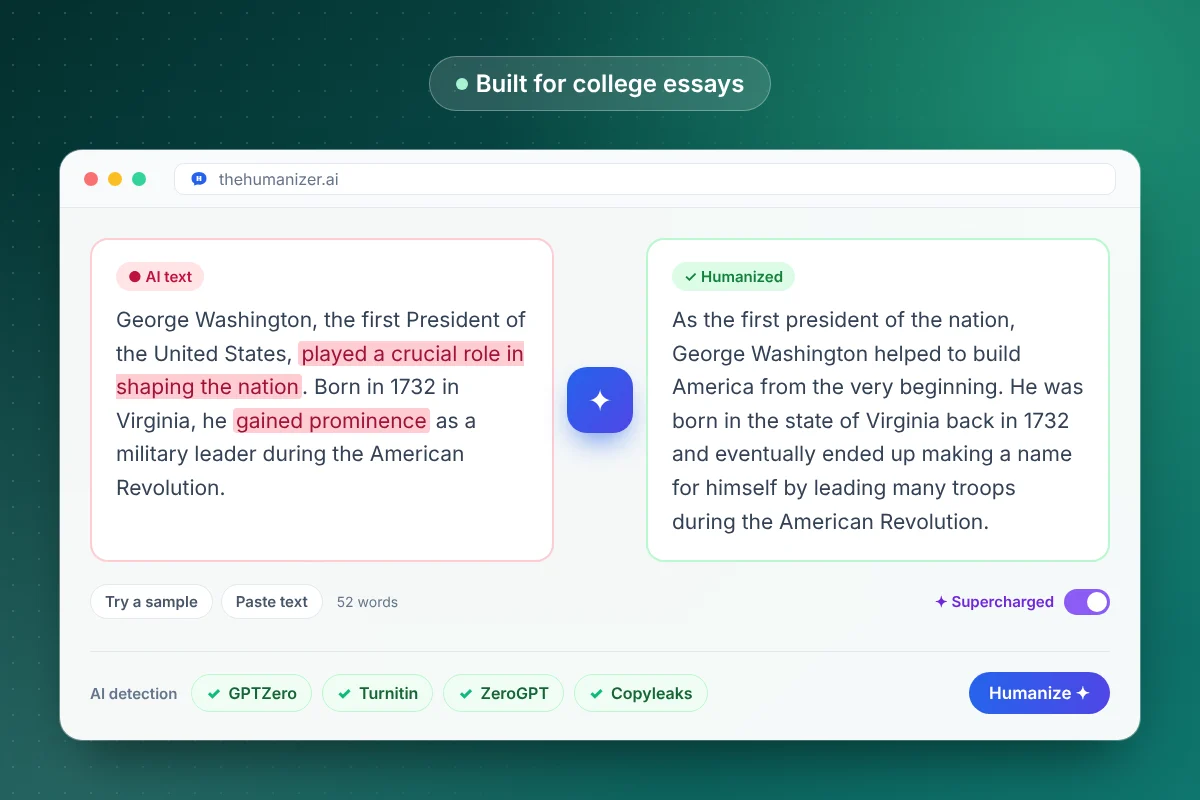
- Paste the paragraphs that sound least like you, at least 50 words at a time. Free and Basic take up to 400 words per run; Pro and Ultimate can take a full essay in one pass with Supercharged mode.
- Click Humanize and compare the result with your original, line by line. Keep what sounds like you. Put back any detail that got softened.
- Read it aloud and get a human reader, such as a counselor, teacher, or family member who knows you.
- Optionally, check it with our free AI detector, which estimates AI-likeness from writing patterns.
The free plan's 350 words a month covers a paragraph or two, enough to try it on the section that bothers you most.
Do colleges check application essays for AI?
Schools don't all say how they review essays, and practices vary. What admissions readers can always do is compare your essay with the rest of your application: your short answers, your activities, your recommendations. An essay that sounds nothing like the rest of you stands out for that reason alone, detector or not.
That's the strongest argument for keeping AI in a supporting role. Write the essay you'd be comfortable discussing in an interview. Our article on whether professors can detect ChatGPT covers how human readers spot AI writing, and much of it applies to any careful reader.
What if a detector flags an essay you wrote yourself?
Stay calm and keep your evidence. Save your drafts, outlines, and version history in Google Docs or Word, since they show how the essay came together. If a school or counselor raises a concern, offer to walk through your process.
Our guides on how to prove you didn't use AI and what to do if you're falsely accused go step by step, and why AI detectors have false positives explains why this happens to honest writers.