Why do AI cover letters sound generic?
Ask ChatGPT, Claude, or Copilot for a cover letter and you'll often get the same moves:
- Stock openers like "I am writing to express my interest in..." or "I am excited to apply for..."
- Résumé clichés such as "proven track record," "passionate about," and "results-driven"
- Three adjectives in a row, followed by three bullet-style achievements
- Paragraphs of the same length, each starting with "I"
- A closing paragraph that repeats everything above it
None of it is wrong. It's just what everyone else sent. Our AI word checker highlights this vocabulary, and if your draft came from ChatGPT, the ChatGPT text cleaner strips the em dashes and markdown it tends to leave behind. Curious why it uses so many? See why ChatGPT uses em dashes.
Do employers check cover letters for AI?
There's no single answer. Hiring teams rarely say whether they run application documents through an AI detector, and practices differ between companies. What you can count on is this: if your letter reaches a recruiter or hiring manager, a person reads it, and people notice letters that sound templated.
So the goal isn't to beat a tool. It's to sound like a specific person applying for a specific job. If you want a quick read on how machine-like your draft sounds, our free AI detector estimates AI-likeness from writing patterns, and our explainer on how AI detectors work covers what those patterns are.
How do you humanize a cover letter?
- Give the AI real material. Paste in the job post and your actual résumé points, not a vague description of yourself.
- Trim the draft to three or four short paragraphs before you humanize it.
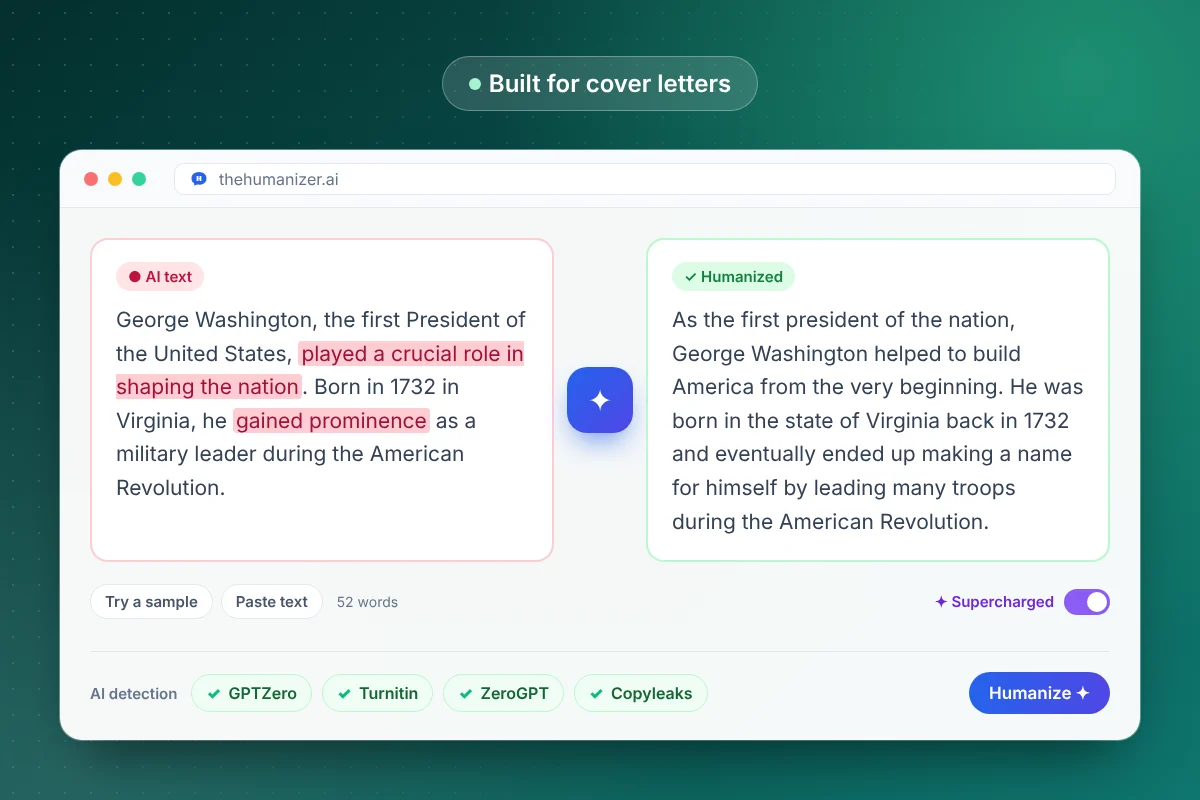
- Paste it into The Humanizer and click Humanize. Each run takes 50 to 400 words on Free and Basic, which covers a short one-page letter; Pro and Ultimate handle longer texts with Supercharged mode.
- Personalize it. Add one detail about the company that shows you looked, and one result with a number.
- Proofread names and facts: company name, job title, dates, and figures.
Want the AI draft to start closer to human? Try the prompts in ChatGPT prompts to sound human before you humanize.
What makes a cover letter sound like a real person?
Specifics. Compare:
| AI-sounding line | More human version |
|---|---|
| I am excited to apply for the Marketing Coordinator role. | I've used your scheduling app for two years, and this is the one job I'd apply for today. |
| I have a proven track record of driving results. | Last spring I rebuilt our newsletter and doubled its open rate in four months. |
| I am confident my skills align with your needs. | Your post mentions a lot of event work. I ran twelve events last year on almost no budget. |
The examples are made up, but the pattern holds: a concrete detail, a number, and a sentence that only fits this one job. The Humanizer gives you natural rhythm. Details like these are what make the letter yours.
Is it OK to use AI for a cover letter?
AI can help with a first draft, and a humanizer is one more editing step. The line that matters is honesty. Every claim in the letter has to be true, every achievement has to be yours, and you should be able to talk about any of it in an interview. If an employer states a policy on AI in applications, follow it.
One practical test: for each sentence, ask whether you could back it up with an example if the interviewer asked. If you can't, rewrite it or cut it. That habit does more for a letter's credibility than any tool.
If English is your second language, a humanizer can help your letter read fluently without changing what you're saying. Our guide for ESL writers covers that use in more detail.
Can it help with other job application writing?
Yes. The same approach works on follow-up emails, LinkedIn summaries, and longer application answers, as long as each piece is at least 50 words. The Humanizer works on text from any AI model, including ChatGPT, Claude, and Copilot. For a broader look at turning AI drafts into natural writing, see our AI to human text converter.