
What is Crossplag?
Crossplag began as a platform for detecting academic plagiarism, known for matching text across languages, including translations. It released a free AI Content Detector in late 2022, and reporting at the time described the first version as a RoBERTa model fine-tuned on GPT-2 output.
In July 2023, Inspera, a Norwegian digital exam company, acquired Crossplag, and the Crossplag product has since been renamed Inspera Originality. The crossplag.com address now points to Inspera's site, though the free Crossplag detector app was still online when we wrote this page.
If terms like RoBERTa, classifier, or AI score are new to you, our AI detection glossary explains them in plain English, and how AI detectors work covers the bigger picture.
How does Crossplag's AI Content Index work?
The updated version of the detector (v2.0) reads up to 3,000 words per check, up from 1,000 in the first version, and according to its own notes it only works on English text.
The result is simple. You get a marker on the AI Content Index, a scale from 0% to 100% with Human, Mix, and AI zones, plus a one-line verdict such as "This text is mainly written by a human." There's no long report to read.
That simplicity has a downside. The index gives one reading for the whole text, so a single stiff, predictable paragraph can drag everything toward Mix. Humanize the full text, not just the parts you're worried about. The patterns it reacts to are the ones described in our guide to perplexity and burstiness.
What did our Crossplag test show?
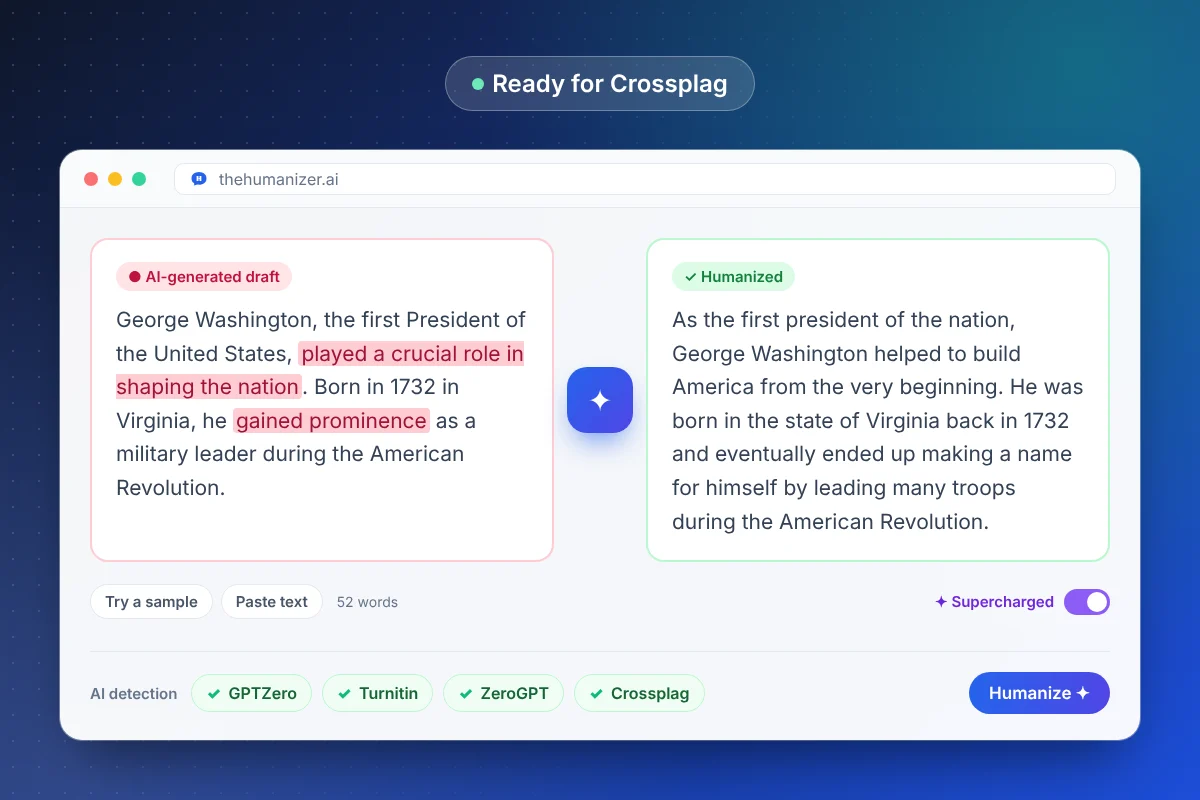
The humanized George Washington sample in our screenshot reads like a student wrote it, not a model. A few things stand out:
- Sentence length varies, from short statements to long ones with several clauses
- Phrasing is plain and specific ("ended up making a name for himself," "just stepped up") rather than polished and generic
- Small informal touches like "back in 1732" break the careful, even tone AI text tends to have
- The facts are all still there: born in Virginia in 1732, the Continental Army, independence in 1783, president in 1789, the two-term precedent, and the warning in his farewell address
That's what The Humanizer is built to do: change rhythm, structure, and word choice while keeping meaning, facts, and citations. It worked in our test, but results vary by text, so check your own before you rely on it.
How do you humanize text for Crossplag?
- Prepare the text. Crossplag's detector reads English only, so humanize and check English text. Clear out markdown, headings, and hidden characters first with our ChatGPT text cleaner.
- Humanize it. Each run takes at least 50 words. Free and Basic handle up to 400 words per run; Pro and Ultimate can use Supercharged mode for longer texts in one pass.
- Review the output. Confirm names, dates, and figures, and add a detail of your own where it helps.
- Check it in Crossplag. Split anything over 3,000 words into parts. For a quick first pass, our free AI detector estimates AI-likeness from writing patterns.
- Re-humanize any part that lands in Mix or AI, then check again.
Why might Crossplag flag your own writing?
Every AI detector produces false positives, and a single-score tool gives you little to go on when it happens. Formal writing, tightly structured essays, and writing by non-native English speakers tend to look regular, and regular is what detectors read as AI.
If you wrote something yourself and Crossplag put it in the AI zone, don't panic. Read why AI detectors have false positives, and if you're working in your second language, our guide for ESL writers explains why you're more likely to be flagged. If you need to defend your work, how to prove you didn't use AI lists the evidence that helps.
Does passing Crossplag mean you'll pass other detectors?
Not always. Crossplag, GPTZero, ZeroGPT, and Turnitin are trained differently and set different thresholds, so the same paragraph can score differently in each. If you know which detector will read your work, check against that one.
Our guide to bypassing AI detection compares the major detectors, and our pages on ChatGPT text and Claude text cover the habits of the models that probably wrote your draft.