Perplexity and Burstiness Explained (With Simple Examples)
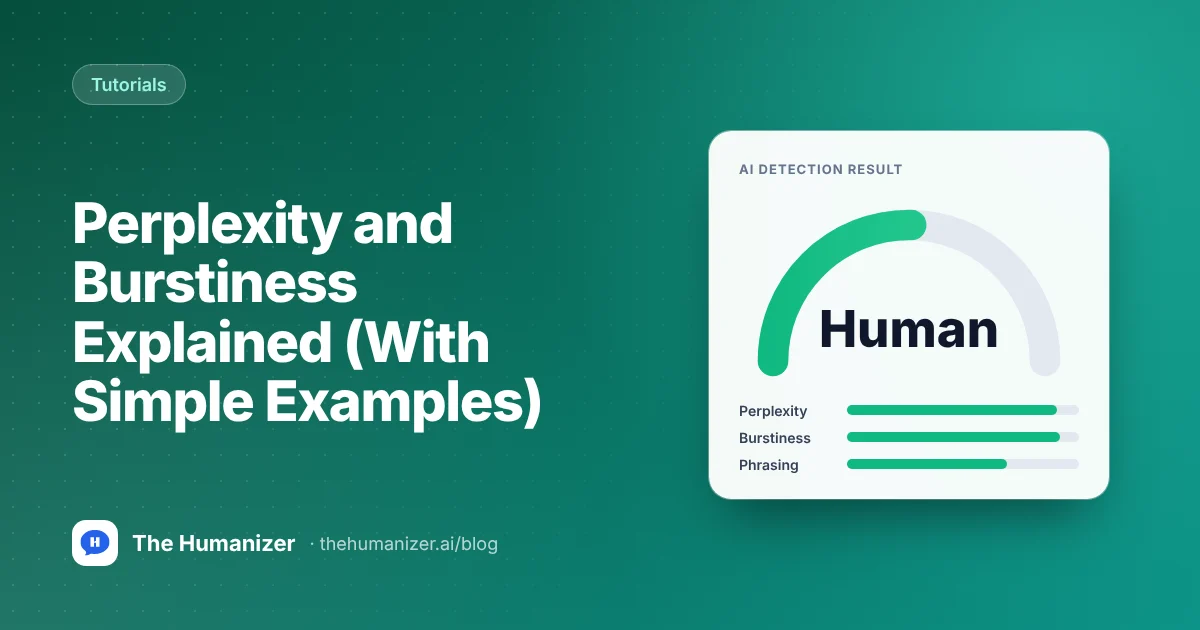
Perplexity measures how predictable your words are. Burstiness measures how much your sentences vary. See how AI detectors use both and where they fall short.
Key takeaways
- Perplexity measures how predictable text is to a language model. Low perplexity means each word is roughly what the model expected.
- Burstiness measures variation across a document, including how much sentence length and structure change.
- AI text tends to score low on both, but so does formal, technical and second-language human writing.
- GPTZero says it stopped using perplexity and burstiness directly in autumn 2023, though modern detectors still react to the same patterns.
- You can raise burstiness naturally by mixing sentence lengths, varying openings and adding specific details.
In this guide
Perplexity measures how predictable a piece of text is to a language model: low perplexity means each word is roughly the word the model expected. Burstiness measures how much that predictability, and sentence length and structure, varies across a document. AI-generated text tends to score low on both. Human writing usually swings more.
Both ideas come up constantly in conversations about AI detectors. Here's what they mean in plain English, how detectors use them, and why neither one can tell who wrote something.
What is perplexity?
Perplexity is a measure of surprise. A language model reads your text one word at a time and, at each step, estimates how likely the next word is. If the actual word is one it expected, perplexity stays low. If the word surprises it, perplexity goes up.
Try it yourself. Finish this sentence: "I take my coffee with milk and..."
- "sugar" is what almost everyone expects. Low perplexity.
- "a little regret" is possible but surprising. High perplexity.
GPTZero's original explainer used a similar example: after "Hi there, I am an AI...", the word "assistant" is predictable and "potato" is not.
Language models are built to pick likely words, so their own writing tends to be low-perplexity. Each word is roughly the word you'd expect. People make odder choices: a specific name, a personal aside, an unusual verb.
Perplexity in a real paragraph
Here are two versions of the same idea.
Low perplexity: "Exercise is good for your health. It can improve your mood, increase your energy and help you sleep better. Experts recommend regular physical activity for people of all ages."
Higher perplexity: "My doctor never told me to exercise more. She told me to walk to the pharmacy instead of driving, which somehow worked. Three weeks later, I was sleeping through the night."
The first paragraph is accurate and clear. It's also exactly what a model would write, because every phrase is common.
One detail matters: perplexity is always measured by a particular model. Different models give different numbers for the same text, so there's no universal cutoff that separates human writing from AI.
Is perplexity the same as Perplexity AI?
No. Perplexity AI is an AI search company that borrowed the name. Perplexity as a measurement is an older idea from language modeling, used to judge how well a model predicts text. When people talk about perplexity in AI detection, they mean the measurement.
What is burstiness?
Burstiness measures variation. GPTZero defined it as how much perplexity varies across a whole document. People also use the word more loosely for variation in sentence length and structure.
Human writing tends to come in bursts. A long sentence that wanders through an idea, picks up a second thought and lands somewhere unexpected. Then a short one. AI writing tends to keep a steady, medium-length rhythm, paragraph after paragraph.
Here's an illustrative comparison of sentence lengths in two five-sentence paragraphs:
| Sentence | AI-style draft (words) | Human-style draft (words) |
|---|---|---|
| 1 | 18 | 27 |
| 2 | 20 | 5 |
| 3 | 17 | 14 |
| 4 | 19 | 9 |
| 5 | 18 | 22 |
The left column has low burstiness: every sentence is about the same length. The right column swings, which reads as more human. You can see your own pattern by pasting a paragraph into our sentence length checker, which shows each sentence's length so flat stretches stand out.
How do AI detectors use perplexity and burstiness?
Early on, quite directly. GPTZero helped popularize both terms in early 2023, scoring text on how predictable it was and how much that predictability varied. Turnitin's 2023 FAQ described the same intuition: models "tend to generate the next word in a sequence of words in a consistent and highly probable fashion," while human writing "tends to be inconsistent and idiosyncratic."
Detectors have moved on since then. GPTZero's own help page now says it no longer uses perplexity and burstiness for its AI detection, because it moved to a deep-learning model in autumn 2023. Most modern detectors work this way: they're classifiers trained on large sets of labeled human and AI text, and they learn their own features.
Those learned features still overlap heavily with the old ideas. A classifier trained to separate human from AI writing ends up sensitive to predictable wording and flat rhythm, because those are real differences. So perplexity and burstiness remain the clearest way to understand what a detector reacts to, even when it doesn't calculate them by name. For the full picture, see how AI detectors work, and for related terms, our AI detection glossary.
What are the limits of perplexity and burstiness?
They measure style, not authorship. That leads to predictable failures.
| Situation | What happens | Why |
|---|---|---|
| Formal or technical writing | Human text scores low perplexity | Standard phrasing is predictable |
| Second-language writing | Human text looks AI-like | Smaller, safer vocabulary |
| Famous or widely copied texts | Human text looks AI-like | Models have seen the wording many times |
| Short samples | Unstable results | Too few sentences to measure variation |
| Edited AI text | AI text looks more human | Edits change the numbers, not the origin |
The second row is well documented. A 2023 Stanford study found seven detectors labeled about 61% of TOEFL essays by non-native English speakers as AI on average, and the researchers tied the problem to perplexity. The third row likely explains some famous misfires, such as an AI detector rating the Declaration of Independence as AI-written, which we cover in is ZeroGPT accurate.
Settings change the numbers too. A model run with more randomness produces higher-perplexity text without being any more human in substance, and a person who writes in short, plain sentences can look flat without any AI involved.
The takeaway: low perplexity and low burstiness are reasons to look closer, never proof. We explain the wider problem in why AI detectors have false positives.
How can you check your own writing?
You don't need a language model to get a rough read on your own patterns:
- Burstiness: the sentence length checker shows whether your sentences cluster at one length.
- Density: the readability checker shows whether every sentence is equally complex.
- Predictable phrasing: the AI word checker flags stock words and phrases that models overuse.
- Overall impression: our free AI detector estimates AI-likeness from writing patterns.
How do you add variation without ruining your writing?
Aim for natural, not random.
- Mix sentence lengths on purpose. After two long sentences, write a short one.
- Vary how sentences start. Not every sentence needs to open with its subject.
- Use specific details. Names, numbers, places and examples are less predictable than general claims.
- Cut filler. Generic connecting phrases add predictability and little meaning.
- Read it aloud. If it sounds like an instruction manual, change the rhythm.
A before-and-after example
Here's a flat paragraph, where every sentence has about the same length and shape:
"Many students struggle with time management during the semester. Deadlines often overlap across several different classes. Planning ahead can help reduce stress and improve results. A simple weekly schedule is one useful strategy to consider."
And the same idea with more variation:
"Week eight is when it falls apart. Two lab reports, a midterm and a group project all land within four days, and nobody planned for that back in September. A weekly schedule won't fix it. A schedule made in week one, with week eight circled in red, might."
The second version is less predictable and more varied, and it's more specific. That last part does the most work. Random choppiness reads badly; variation that follows your meaning reads like a person.
Our guide to humanizing AI text manually has more techniques. If English isn't your first language, our page for ESL writers covers how to add variety without losing clarity. For AI-assisted drafts, The Humanizer rewrites sentence rhythm, structure and word choice while keeping your meaning, facts and citations. It's designed to pass common detectors, though results vary by text and by tool.
The bottom line
Perplexity measures how predictable your words are, and burstiness measures how much your writing varies. AI text tends to score low on both, but so does plenty of human writing, which is why these measures can explain a detector's reaction without proving who wrote anything.
Want to add natural rhythm to an AI draft? Try The Humanizer free with 350 words a month.
Frequently asked
Questions, answered
Written by
The Humanizer Team
Editorial