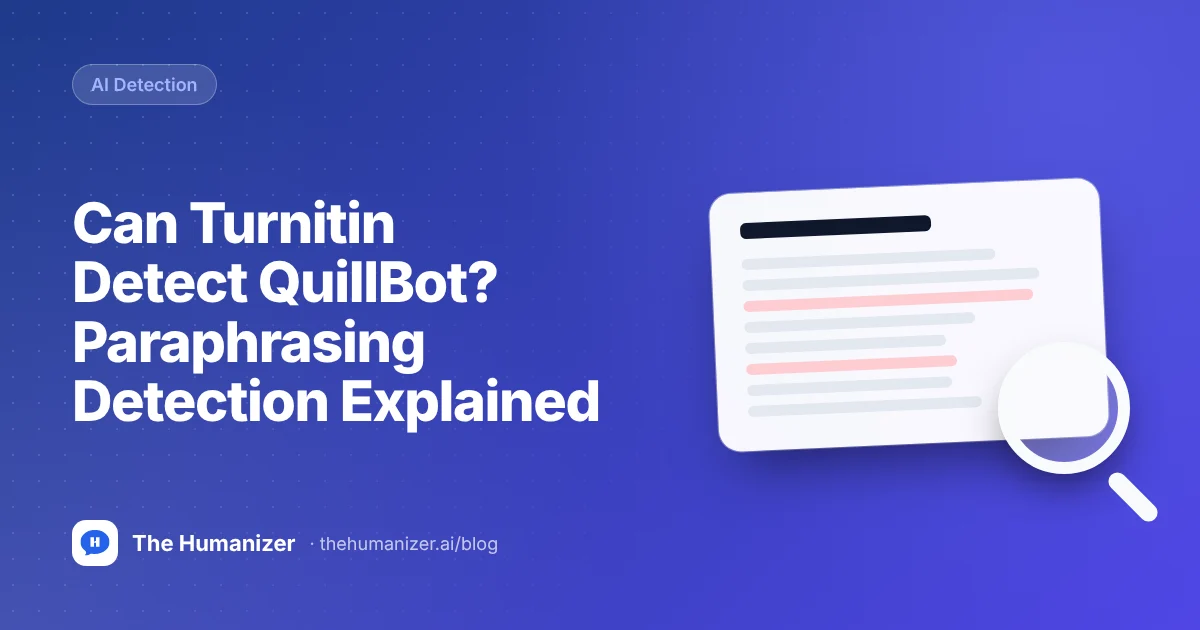
Can Turnitin Detect QuillBot? Paraphrasing Detection Explained
Turnitin added AI paraphrasing detection in 2024 to flag AI text reworded by tools like QuillBot. See how it works and why humanizers differ from paraphrasers.
Key takeaways
- Turnitin added AI paraphrasing detection in July 2024 to flag AI-generated text that was reworded by paraphrasing tools or text spinners.
- In August 2025 it added AI bypasser detection aimed at humanizer tools. Both features apply to English submissions.
- Since August 2026, Turnitin's English report shows one set of highlights for likely AI text, including paraphrased or bypassed text.
- Paraphrasers change words but usually keep the AI sentence structure and rhythm, which is what detectors read.
- Paraphrasing a source still needs a citation, and many schools count AI paraphrasing tools as AI assistance.
In this guide
- What did Turnitin announce about paraphrasing tools?
- How can Turnitin detect paraphrased AI text?
- Does QuillBot change your Turnitin similarity score?
- Will Turnitin flag my own writing if I run it through QuillBot?
- Does Turnitin flag QuillBot's grammar checker or summarizer?
- What if you edit the QuillBot output yourself?
- Why are paraphrasers and humanizers different?
- What should you do if you've used QuillBot?
- The bottom line
Often, yes. In July 2024, Turnitin added AI paraphrasing detection to its AI writing report. It's built to flag text that was likely written by AI and then reworded by a paraphrasing tool or text spinner, which is exactly what QuillBot does. It runs automatically wherever a school has AI detection enabled, and it covers English submissions.
That doesn't mean every QuillBot sentence gets caught, or that every flag is correct. Here's what Turnitin announced, how paraphrase detection works, and why a paraphraser and a humanizer are different tools.
What did Turnitin announce about paraphrasing tools?
Turnitin has expanded its AI detection in stages:
| Date | What Turnitin announced |
|---|---|
| 2023 | AI writing detection launched, trained at first on GPT-3 and GPT-3.5 output |
| July 2024 | AI paraphrasing detection for AI text reworded by paraphrasing tools or text spinners |
| August 2025 | AI bypasser detection for AI text modified by humanizer tools, English only |
| August 2026 | One set of highlights in the English report for likely AI text, including paraphrased or bypassed text |
In its July 2024 announcement, Turnitin said the feature flags cases where AI paraphrasing tools may have modified AI-generated text to avoid detection. The report then split likely AI text into two groups: likely AI-generated, and likely AI-generated and AI-paraphrased. Turnitin's chief product officer described paraphrasing AI output as a likely sign that a writer is trying to hide their use of AI.
Turnitin didn't name QuillBot in that announcement. QuillBot is simply the best-known example of the kind of tool it described.
Since August 2026, Turnitin's English report no longer gives the paraphrased category its own color. It shows one set of highlights for likely AI text, including text that may have been paraphrased or run through a bypasser, and the breakdown is still available in the report's AI writing tab. Turnitin says the single color is meant to reduce misreadings of tool-specific distinctions. It also says only its English detector includes paraphrasing and bypasser detection; its Spanish and Japanese detectors don't.
How can Turnitin detect paraphrased AI text?
Turnitin hasn't published the full details, but the basic idea is simple. A paraphraser changes the surface of a text: it swaps words for synonyms, reorders clauses, and stretches or trims phrases. It mostly leaves the deeper structure alone. The sentence skeleton, the paragraph logic and the even rhythm of the original AI draft survive.
Turnitin was testing this early on. Its 2023 FAQ said that in lab tests with paraphrasing tools, "in most cases, our detector has retained its effectiveness and is able to identify text as AI-generated even when a paraphrasing tool has been used to change the AI output." The 2024 feature turned that into a separate, labeled category in the report.
Synonym swaps can also leave their own traces: a word that's technically correct but slightly off, stiff phrasing, or a formal term dropped into a casual sentence. Readers notice those as much as detectors do.
What paraphrasing looks like to a detector
Here's an illustrative example. An AI draft might say: "Social media has a significant impact on the mental health of teenagers, affecting their self-esteem, sleep patterns, and social relationships."
A typical paraphrase: "Social networking platforms have a considerable effect on the psychological well-being of adolescents, influencing their self-image, sleep habits, and interpersonal connections."
Almost every word changed. The structure didn't: same opening claim, same verb pattern, same list of three at the end, roughly the same length. That skeleton is what a detector reads.
A person writing from experience might say: "Ask a 15-year-old why they're awake at 1 a.m. and the answer is usually a phone. The self-esteem part shows up later." Different rhythm, different shape, and a specific detail no paraphraser would add.
Does QuillBot change your Turnitin similarity score?
It can, but that's a separate question. Turnitin's similarity report compares your text with web pages, publications and past submissions. Rewording a source can reduce exact matches. It doesn't make the idea yours. Paraphrasing someone else's work without citing it is still plagiarism, whether a person or a tool did the rewording.
So QuillBot can affect two checks in opposite directions: fewer similarity matches, and a possible AI flag on the reworded text.
Will Turnitin flag my own writing if I run it through QuillBot?
It might. Turnitin's paraphrase detection is aimed at AI-generated text that was then paraphrased, and Turnitin hasn't said exactly how it treats human writing run through a paraphraser. Don't assume it's safe. A paraphraser is itself an AI tool, and the sentences it produces are machine-written.
Many students use QuillBot to smooth their English, especially when writing in a second language. If that's you, check whether your course counts paraphrasing tools as AI assistance, keep your original draft, and be ready to show it. Our page for ESL writers has other ways to improve flow without handing your sentences to a tool.
Does Turnitin flag QuillBot's grammar checker or summarizer?
QuillBot offers more than a paraphraser, and Turnitin hasn't published tool-by-tool guidance, so think about what each tool does to your text. A grammar checker that fixes spelling and agreement leaves your own sentences in place, and EdSurge reported in 2024 that Turnitin's internal tests found traditional grammar checkers don't set off its detector. A summarizer or paraphraser writes new sentences for you, which is the kind of text Turnitin is built to catch. We cover the grammar-checker side in does Grammarly get flagged as AI.
What if you edit the QuillBot output yourself?
Editing helps in proportion to how much you change. Fixing a few words leaves the AI structure intact. Rewriting sentences from scratch, adding your own examples and reorganizing paragraphs turns the text into your work, which is the point of most assignments anyway. Turnitin highlights text sentence by sentence, so lightly edited passages can still be flagged inside an otherwise human essay. Mixed documents are also harder for any detector to score cleanly, which means a partial flag isn't proof of anything on its own.
Why are paraphrasers and humanizers different?
They solve different problems. A paraphraser was built to say the same thing in different words. A humanizer is built to change how text reads, at the level of rhythm and structure that detectors measure.
| Paraphraser (like QuillBot) | AI humanizer | |
|---|---|---|
| Main goal | Reword text | Make text read naturally |
| What it changes | Words and phrases | Sentence rhythm, structure and word choice |
| What usually survives | The AI sentence skeleton and rhythm | Your meaning, facts and citations |
| How Turnitin treats it | Targeted by paraphrase detection since 2024 | Targeted by bypasser detection since 2025 |
We go deeper in AI humanizer vs paraphraser, and compare the two tools directly in The Humanizer vs QuillBot. QuillBot also runs its own AI detector, which we cover in our QuillBot AI detector guide.
One honest caveat: Turnitin's bypasser detection targets humanizer tools too. No tool is a free pass, and anyone promising one isn't being straight with you. The Humanizer rewrites structure and rhythm rather than swapping synonyms, and it's designed to pass common detectors, but results vary by text and by detector.
What should you do if you've used QuillBot?
- Check your course policy. Many schools count AI paraphrasing tools as AI assistance. Our guide to academic AI policies covers the common rules.
- Cite what you paraphrased. If you reworded a source, it still needs a citation.
- Keep your originals. Save your own draft and your version history.
- Rewrite in your own voice. Add your examples, your reasoning and details from class.
- Check before you submit. Use our free AI detector as a first pass, then look at the passages that stand out.
- Disclose it if required. If your course allows paraphrasing tools with disclosure, say which tool you used and for which parts.
If your work is AI-assisted and your course allows it, our page on preparing AI-assisted drafts for Turnitin explains where The Humanizer fits. For other models, see can Turnitin detect Claude and Gemini, and for reading the report itself, the Turnitin AI score explained.
The bottom line
Turnitin can often detect QuillBot-paraphrased AI text. It added AI paraphrasing detection in July 2024 and bypasser detection in August 2025, both for English. Paraphrasing changes words, not the patterns underneath, and it never replaces citing your sources.
If you need AI-assisted drafts to read like natural writing, try The Humanizer free with 350 words a month.
Frequently asked
Questions, answered
Written by
The Humanizer Team
Editorial