Is ZeroGPT Accurate? What Its Score Means and When to Doubt It
ZeroGPT is quick and free, but it has flagged famous human texts as AI and missed AI rewrites. Learn what its percentage means and how to read your results.
Key takeaways
- ZeroGPT can catch obvious AI text, but it isn't reliable enough to prove who wrote something.
- In Decrypt's 2024 tests, ZeroGPT rated the Declaration of Independence about 98% AI and labeled a ChatGPT-4o rewrite as human.
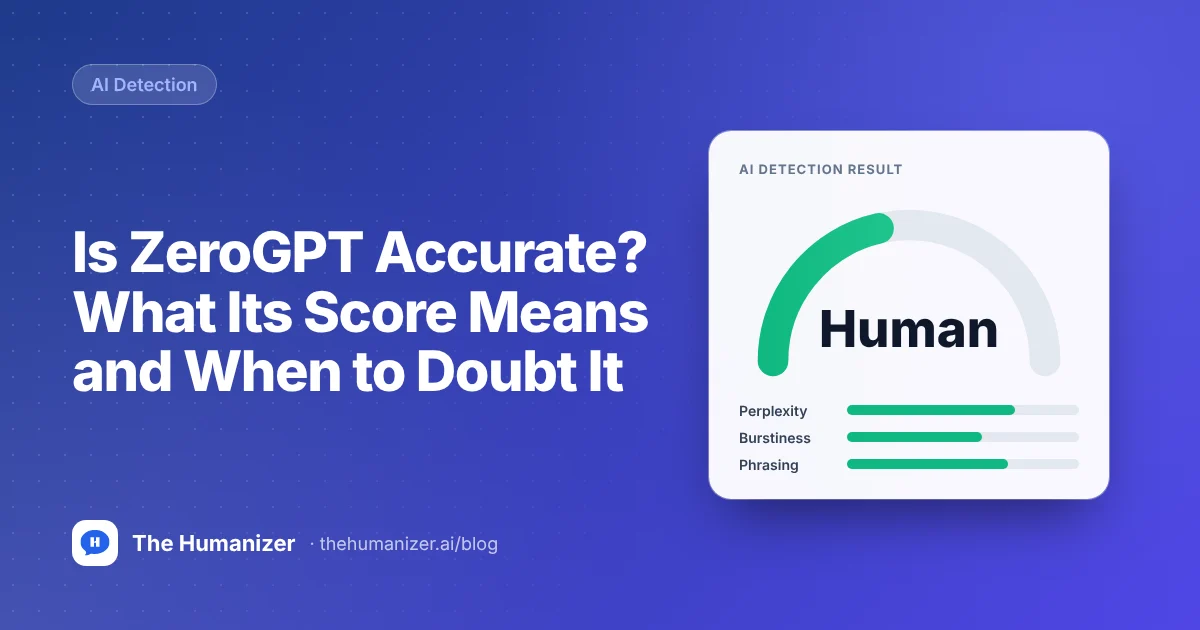
- Its percentage shows how much of the text it labels as AI, not the probability that you used AI.
- ZeroGPT's advertised 98.4% accuracy is the company's own figure; we found no independent test that reproduces it.
- Read the highlighted sentences, test longer sections, and weigh any score against drafts and version history.
In this guide
- What is ZeroGPT, and how does it work?
- What does the ZeroGPT percentage mean?
- Is ZeroGPT accurate? What independent tests show
- How does ZeroGPT compare with GPTZero and Turnitin?
- Why do ZeroGPT and other detectors disagree?
- Is ZeroGPT useful for checking your own work?
- How should you read a ZeroGPT result?
- What should you do if ZeroGPT flags your writing?
- The bottom line
ZeroGPT can catch obvious, unedited AI text, but it isn't accurate enough to prove who wrote something. In independent tests it has both flagged famous human writing as AI, including the Declaration of Independence, and missed AI-written text. Treat its percentage as a rough signal, read the highlighted sentences, and compare it with other evidence.
Below: what ZeroGPT's number means, what the tests show, and how to read a result fairly.
What is ZeroGPT, and how does it work?
ZeroGPT is a free web-based AI detector. You paste text into a box, and it returns a percentage along with highlighted sentences it thinks were written by AI. It's popular because it's fast and free.
ZeroGPT says its results come from what it calls DeepAnalyse technology, a model it describes as trained on many languages and multiple LLMs. It doesn't publish much detail beyond that, and we couldn't find independent tests of how well it performs outside English, so be extra careful with non-English results. Its homepage advertises 98.4% detection accuracy and a false positive rate under 1%. Those are the company's own figures, and we couldn't find independent testing that reproduces them.
Don't confuse it with GPTZero. The names are similar, but they're separate detectors from different companies, with different models. If you're looking at GPTZero results, read is GPTZero accurate instead.
What does the ZeroGPT percentage mean?
ZeroGPT's percentage is meant to show how much of your text it considers AI-generated, with the flagged sentences highlighted. A 35% result means it labeled sentences making up roughly a third of the text as AI. It doesn't mean there's a 35% chance you used AI, and it isn't a measure of how confident the tool is.
A few things follow from that:
- A mixed score is normal. Most real writing gets some sentences flagged.
- The highlights matter more than the number. They show where the tool reacted, which is the part you can actually look at.
- Short texts swing. On a paragraph or two, a handful of edits can move the score a lot.
| What you see | What it suggests | What to do |
|---|---|---|
| Low score, few highlights | Few sentences matched AI patterns | Nothing urgent |
| Middle score | Some sentences look AI-like | Read the highlighted lines |
| High score on your own writing | Possible false positive | Gather drafts and test full sections |
| High score on an AI draft | The AI patterns are still intact | Revise structure, not just words |
Is ZeroGPT accurate? What independent tests show
The best-known test is a strange one. Data scientist Christopher Penn drew attention to an AI detector rating the Declaration of Independence as mostly AI-written. Decrypt then ran its own tests on four detectors in October 2024, and ZeroGPT rated the Declaration 97.93% AI-generated, the worst result of the group. The document was written in 1776.
Decrypt's second test went the other way. It compared E.M. Forster's 1909 story "The Machine Stops" with a ChatGPT-4o rewrite of it. ZeroGPT labeled both versions as human-written, missing the AI version.
Those two results capture the core problem. A detector can be wrong in both directions: flagging famous human writing and passing AI text. Decrypt quoted Penn calling detectors like these "unsophisticated and harmful." Even detector makers urge caution: in the same article, GPTZero's CTO said, "We would recommend against using AI detection results to directly discipline students."
Why does ZeroGPT flag human writing?
ZeroGPT doesn't explain individual results, but the likely reasons are the same ones that trip up most detectors:
- Famous texts are everywhere. The Declaration of Independence appears all over the web and in the material models learn from, so its wording is very familiar and predictable to a model.
- Formal writing is predictable. Legal, academic and historical prose uses standard phrasing and long, balanced sentences.
- Second-language writing uses safer words. A 2023 Stanford study found seven popular detectors labeled about 61% of TOEFL essays by non-native English speakers as AI on average.
- Short samples carry little signal. A few sentences aren't enough to judge.
We go into the mechanics in why AI detectors have false positives and perplexity and burstiness explained.
How does ZeroGPT compare with GPTZero and Turnitin?
| Detector | Who usually runs it | What the score shows | Who sees the result |
|---|---|---|---|
| ZeroGPT | Students, writers, editors | Share of text it labels AI | Whoever runs the check |
| GPTZero | Teachers, students, editors | A classification with probabilities | Whoever runs the check |
| Turnitin | Schools and universities | Share of qualifying prose it flags | Usually instructors only |
The last column matters most. If your work is going to a school that uses Turnitin, a ZeroGPT result tells you little about what your instructor will see. Our comparison of GPTZero, Turnitin and Copyleaks shows how differently detectors behave on the same text.
Why do ZeroGPT and other detectors disagree?
Run the same paragraph through ZeroGPT, GPTZero and Turnitin and you can get three different answers. That's normal, for a few reasons:
- Different training data. Each company trains on its own mix of human and AI text, so each learns slightly different patterns.
- Different thresholds. One tool may label a sentence AI at a lower level of confidence than another.
- Different units. Some score sentence by sentence, others score overlapping chunks or the whole document.
- Different reporting. A share of sentences, a probability and a classification aren't the same number, even when they look alike.
Disagreement doesn't mean one tool is right and the others are broken. It means all of them are estimating.
Is ZeroGPT useful for checking your own work?
It can be, as long as you know its limits. ZeroGPT is quick, free and shows which sentences it reacted to, which makes it handy for spotting flat or generic passages in a draft. Its text box has a character limit, so very long documents may need checking in sections.
What it can't do is tell you what another detector will say. If your work goes to a school that uses Turnitin or a client that uses Originality.ai, that tool's result is the one that counts. And don't chase a perfect score by rewriting good sentences into awkward ones. Readers matter more than any single detector.
The most useful way to use it is as an editing prompt. Look at the flagged sentences, ask whether each one says something specific, and rewrite the ones that don't. Then read the whole piece again for flow.
How should you read a ZeroGPT result?
- Test enough text. Paste a full section or the whole piece, not a single paragraph.
- Read the highlights. Look for shared patterns: the same sentence openers, the same length, the same stock phrases.
- Run it again after small edits. If the score jumps around, the result is unstable and shouldn't carry much weight.
- Compare with another tool. Our free AI detector estimates AI-likeness from writing patterns. Agreement between tools means more than one high score.
- Check the patterns yourself. Our AI word checker finds overused AI phrasing, and the sentence length checker shows whether your rhythm is flat.
- Weigh it against real evidence. Drafts, notes and version history say far more about who wrote something than any score.
What should you do if ZeroGPT flags your writing?
If you wrote it yourself, don't rewrite good work in a panic. Keep your drafts and version history, and if someone raises the score with you, show them your process. Our checklist on how to prove you didn't use AI walks through it. If English is your second language and your writing keeps getting flagged, our page for ESL writers explains why and what helps.
If you used AI to help draft it, check that AI use was allowed, then revise for structure and rhythm, not just vocabulary. Swapping words rarely moves the score much. The Humanizer rewrites sentence rhythm, structure and word choice while keeping your meaning and citations. It's designed to pass ZeroGPT and other common detectors, though results vary. See how it handles ZeroGPT specifically.
The bottom line
Is ZeroGPT accurate? It can catch obvious AI text, but independent tests have shown it flagging the Declaration of Independence and missing an AI rewrite. Use its score as a rough first look, read the highlights, and never treat it as proof.
To make AI-assisted drafts read naturally, try The Humanizer free with 350 words a month and no credit card.
Frequently asked
Questions, answered
Written by
The Humanizer Team
Editorial