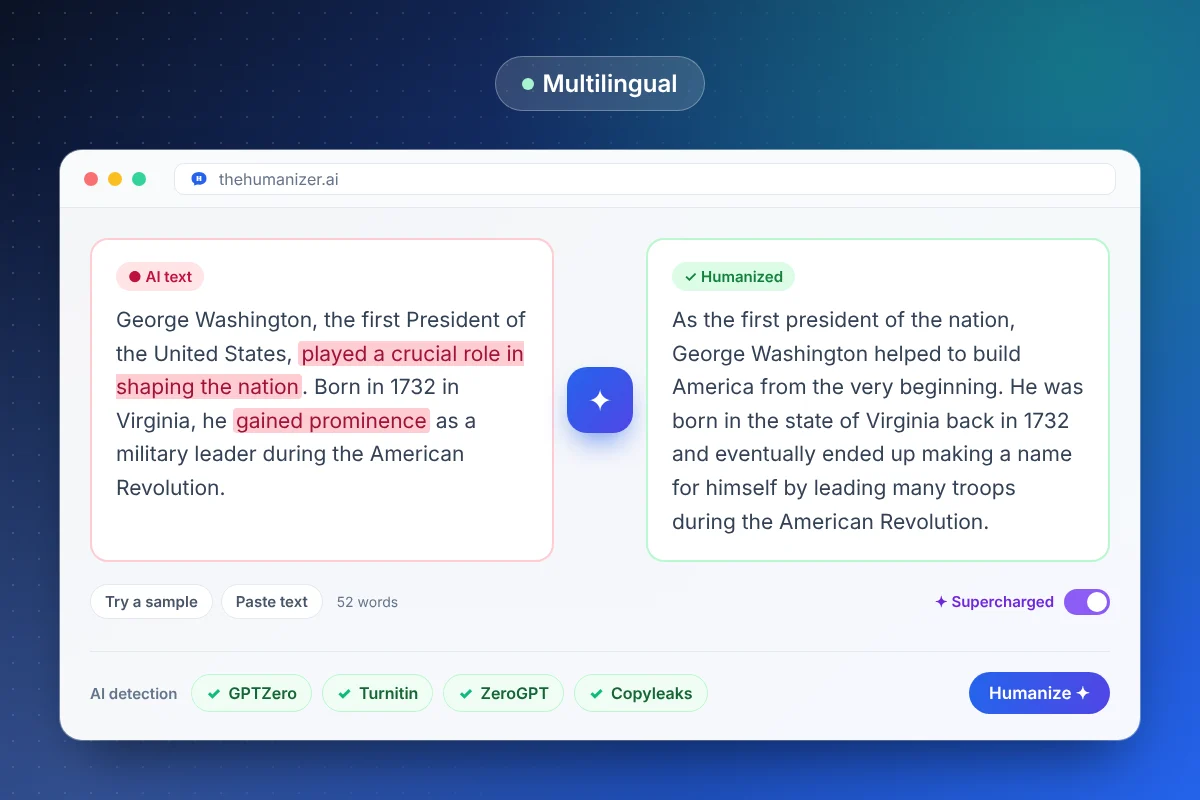
How does humanizing work in other languages?
AI models carry the same habits into most languages: even sentence lengths, safe word choices, stock transitions and a slightly stiff, formal tone. In Spanish, that might be paragraph after paragraph opening with "Además" or "Cabe destacar que". In German, it's long, noun-heavy sentences that all have the same shape. A native reader notices, even if they can't say why.
The Humanizer rewrites those patterns in the same language. It varies sentence rhythm and structure and swaps predictable phrasing for something more natural, while keeping your facts, names, citations and paragraph count. It doesn't translate. Our explainer on how AI detectors work covers the patterns in more detail, and our AI to human text converter page explains the rewrite itself.
Which languages does The Humanizer support?
The Humanizer works in English, Spanish, French, German, Russian, Japanese, Hindi and more. A few things help in any of them:
- One language per run. Keep each run in a single language for the most natural output. If a Spanish essay quotes an English source, check afterward that the quote is unchanged.
- The same limits in every language. Each run needs at least 50 words. Free and Basic take up to 400 words per run, and Pro and Ultimate use Supercharged mode for longer texts in one pass. The pricing page has the details.
- The same model on every plan. The free AI humanizer gives you 350 words a month to try it in your language.
Should you humanize before or after translating?
After. If you draft in English with ChatGPT and then translate, humanize the translated version, not the English original. Translation, whether by an AI model or a translation app, adds its own patterns: word order copied from the source language, idioms translated literally, and phrasing no native speaker would pick. Humanize first and translate second, and those patterns come right back.
An order that works:
- Draft in whichever language you think in.
- Translate into the language your reader uses.
- Humanize the translated text in The Humanizer.
- Review it with a fluent reader if the text matters, and use text compare to see what changed.
If ChatGPT did the drafting, our guide to humanizing ChatGPT text covers the leftovers to clean up first.
How do you make non-English AI text sound natural?
A few checks catch what any tool can miss:
- Formal or informal address. Pick tú or usted, tu or vous, du or Sie, and keep it the same from start to finish.
- Punctuation. French puts a space before colons and question marks, Spanish opens questions with ¿, and German has its own quotation marks. AI drafts sometimes slip into English habits.
- Idioms. A word-for-word English idiom is one of the clearest signs a text wasn't written in that language.
- Names and terms. Product names, legal terms and technical vocabulary should match what your field uses.
- Local examples. Swap generic examples for ones your readers recognize.
None of this needs an expert. A colleague or friend who speaks the language fluently can usually spot problems in a few minutes.
Do AI detectors work in other languages?
Some do, but language coverage varies a lot from one detector to the next. A few examples:
- According to Turnitin, its AI writing detection covers English, Spanish and Japanese, and it added Arabic in August 2026.
- Turnitin's AI bypasser detection, launched in August 2025 and aimed at text modified by humanizer tools, is limited to English, according to reporting by THE Journal.
- GPTZero says it detects AI in English and more than 20 other languages.
Outside a detector's supported languages, it may not score your text at all, and inside them, results may be less reliable than in English. Check the detector's own language list before you trust a score, and treat any score as a signal, not a verdict. Our guide to whether AI detectors work in other languages goes further.
Can a multilingual humanizer help non-native English writers?
Yes. A 2023 Stanford study (Liang et al.) found that GPT detectors consistently misclassified writing by non-native English speakers as AI-generated. Writing in a second language often relies on common words and regular sentence patterns, which detectors associate with AI. The Humanizer adds natural variety to English you wrote yourself, without changing your ideas.
Our page for ESL writers covers this use in detail, and why AI detectors have false positives explains the bias. If you're a student, follow your institution's AI policy, whatever language you write in.