Is QuillBot's AI Detector Accurate? What Its Results Mean
QuillBot's AI detector is free and quick, but tests show mixed accuracy. Learn how it works, what its four categories mean and how to read your results fairly.
Key takeaways
- QuillBot's AI detector is free without sign-up for scans under 1,200 words and supports six languages.
- It sorts text into four categories: AI-generated, AI-generated and AI-refined, human-written and AI-refined, and human-written.
- Independent tests are mixed: it cleared the Declaration of Independence, missed an AI rewrite and flagged human essays in a 2024 study.
- QuillBot and Scribbr share a parent company, Learneo, so don't treat their results as fully independent.
- Read the breakdown and highlights, test full sections and weigh any score against your drafts.
In this guide
- How does QuillBot's AI detector work?
- What do QuillBot's AI detector categories mean?
- Is QuillBot's AI detector accurate?
- What are the known limits of QuillBot's AI detector?
- Who should use QuillBot's AI detector?
- How should you read a QuillBot AI detector result?
- Are QuillBot and Scribbr the same company?
- How does QuillBot compare with GPTZero and ZeroGPT?
- What should you do if QuillBot flags your writing?
- The bottom line
QuillBot's AI detector is handy for a quick check, but it isn't accurate enough to prove who wrote something. It sorts text into four categories, from AI-generated to human-written, and independent tests have been mixed: it correctly cleared famous human writing, missed an AI rewrite and wrongly flagged a third of the human essays in one study.
Here's how the detector works, what each category means, what the tests show and how to read a result without over-trusting it.
How does QuillBot's AI detector work?
You paste text or upload a document, click "Detect AI" and get a percentage breakdown plus sentence-level highlights. According to QuillBot, it's free with no sign-up for scans of fewer than 1,200 words, and Premium adds bulk uploads for checking many documents at once. You can also download a report of the results.
QuillBot says the detector works by analyzing "linguistic patterns, sentence structure, and word choice" to judge whether text looks more like human or AI writing. It supports six languages: English, French, Spanish, German, Dutch and Portuguese.
The detector sits in the same suite as QuillBot's paraphraser, grammar checker and AI humanizer. QuillBot says that connection helps it distinguish "between assistive and generative AI." That idea is behind its categories.
What do QuillBot's AI detector categories mean?
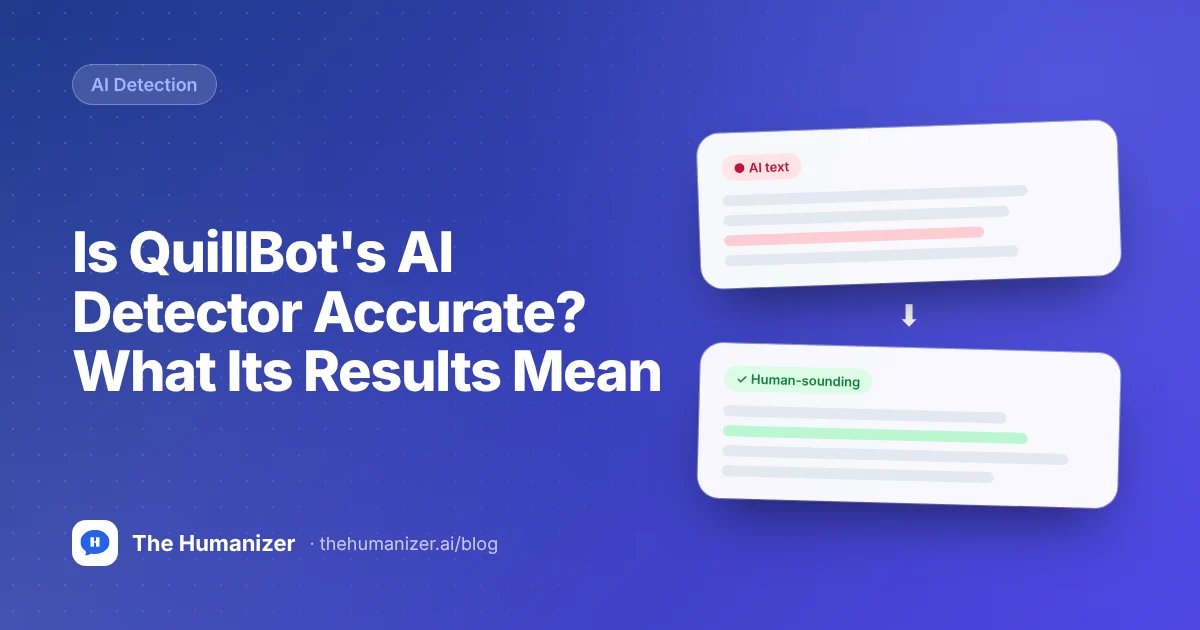
QuillBot labels text as one of four types:
| Category | What QuillBot means | How to read it |
|---|---|---|
| AI-generated | Text generated by AI | The strongest AI signal, but still an estimate |
| AI-generated and AI-refined | AI text that was then edited with an AI tool | Suggests AI drafting plus AI paraphrasing or polishing |
| Human-written and AI-refined | Human text edited with an AI tool | Common after paraphrasing or heavy grammar fixes |
| Human-written | Text written by a person | No AI signal found, which isn't proof either |
QuillBot says this lets you "better understand at what stages and in what capacity AI was used." That's useful in principle, because "I fixed my grammar with a tool" and "a chatbot wrote this" are very different things. In practice, research suggests detectors find the distinction hard. A 2025 study of 12 detectors found they "frequently flag even minimally polished text as AI-generated" and "struggle to differentiate between degrees of AI involvement" (Saha and Feizi, 2025). So treat the line between the two "refined" categories as fuzzy.
Is QuillBot's AI detector accurate?
QuillBot's own guide says "no approach is 100% reliable." Independent tests back that up, with errors in both directions.
| Test | What happened |
|---|---|
| Decrypt, October 2024: the Declaration of Independence | QuillBot called it "Human-written 100%," which was correct |
| Decrypt, October 2024: an E.M. Forster story and a ChatGPT-4o rewrite of it | QuillBot gave both a 0% AI probability, so it missed the AI version |
| Durham University, 2024: 60 short physics essays | It caught all 30 GPT-4 essays but flagged 10 of the 30 human essays as AI, for 83% accuracy |
Two cautions about these tests. They're small, and detectors change over time, so a current version may behave differently. But the pattern matches what research finds across detectors: a tool can be right about one text and wrong about the next, and false positives on human writing are a real risk. We collect more of that research in our AI detection statistics.
What are the known limits of QuillBot's AI detector?
- Short text is unreliable. Every detector has less to go on with a paragraph than with a full essay, so test whole sections.
- Mixed writing blurs the categories. Essays that blend your sentences with edited AI text are hard for any tool to split cleanly.
- Paraphrasing muddies the signal. If you ran your own writing through a paraphraser, including QuillBot's, expect an AI-refined label. The paraphraser's sentences are machine-written.
- Six languages only. Text in other languages isn't covered.
- It isn't your school's detector. A QuillBot score tells you little about what Turnitin will show your instructor. Turnitin has looked for AI-paraphrased text since late 2023, and named QuillBot as an example in its 2024 report update.
- It can't see your process. Like every detector, it judges the final text, not how you wrote it.
- It can't tell your edits from a tool's. If you rewrote AI text heavily yourself, it may still call the result AI-generated or AI-refined, because it judges patterns, not who typed them.
Who should use QuillBot's AI detector?
- Writers checking their own drafts. It's a quick, free way to find passages that read as generic before you send them.
- Students checking their work. It helps you spot stiff passages, but it can't tell you what Turnitin will show your instructor.
- Teachers and editors. It's fine as a first screen, but its categories are estimates, so a flag should lead to a conversation, not a conclusion.
- People writing in other languages. If your language isn't one of the six it supports, use a detector that covers it. Our guide to AI detectors in other languages compares the options.
How should you read a QuillBot AI detector result?
- Look at the breakdown, not just the top number. Note how much text falls into each of the four categories.
- Read the highlighted sentences. Look for what they share: the same opener, the same length, the same stock phrase.
- Test enough text. Paste a full section or the whole piece.
- Run it again after small edits. If the result jumps around, it shouldn't carry much weight.
- Compare with another tool. Our free AI detector estimates AI-likeness from writing patterns, and agreement between tools means more than one score.
- Weigh it against real evidence. Drafts and version history say far more about who wrote something than any detector.
Are QuillBot and Scribbr the same company?
They share an owner. In December 2022, Learneo launched as a parent company for brands including CliffsNotes, Course Hero, LitCharts, QuillBot, Scribbr and Symbolab.
Both brands run their own AI detector pages, and we haven't seen public detail on how much technology the two detectors share. So don't assume a result on one predicts the other, and don't treat agreement between them as two fully independent opinions. If Scribbr is the tool you're facing, see our Scribbr AI detector guide.
How does QuillBot compare with GPTZero and ZeroGPT?
| Detector | How it reports results | Notable test result |
|---|---|---|
| QuillBot | Four categories, including AI-refined | Missed a ChatGPT-4o rewrite in Decrypt's test |
| GPTZero | AI, mixed or human, with a probability and confidence level | Flagged the same rewrite as 95% AI in Decrypt's test |
| ZeroGPT | A percentage of text it considers AI | Rated the Declaration of Independence 97.93% AI |
None of these is reliable enough on its own. For deeper dives, read is GPTZero accurate and is ZeroGPT accurate, or see the main tools side by side in our comparison of AI detectors.
What should you do if QuillBot flags your writing?
If you wrote it yourself, don't panic or rewrite good work into awkward sentences. Keep your drafts and version history, and if someone raises a score with you, show your process. Our checklist on how to prove you didn't use AI walks through it.
If you used QuillBot's paraphraser, expect an AI-refined label, and check whether your course counts paraphrasing tools as AI assistance. Turnitin can often catch paraphrased AI text too, as we explain in can Turnitin detect QuillBot.
If you used AI to draft and that's allowed, revise for structure and rhythm, not just synonyms. Paraphrasers mostly swap words, which is why the AI pattern often survives. A humanizer works differently: The Humanizer rewrites sentence rhythm, structure and word choice while keeping your meaning and citations, and it's designed to pass common detectors, though results vary. Compare the two approaches in The Humanizer vs QuillBot, or see how it handles QuillBot's AI detector.
The bottom line
Is QuillBot's AI detector accurate? It's a useful free first look, and its four categories are a sensible idea, but tests show it can miss AI rewrites and flag human writing. Read the breakdown and highlights, test longer samples and never treat a score as proof.
To make allowed AI-assisted drafts read naturally, try The Humanizer free with 350 words a month and no credit card.
Frequently asked
Questions, answered
Written by
The Humanizer Team
Editorial