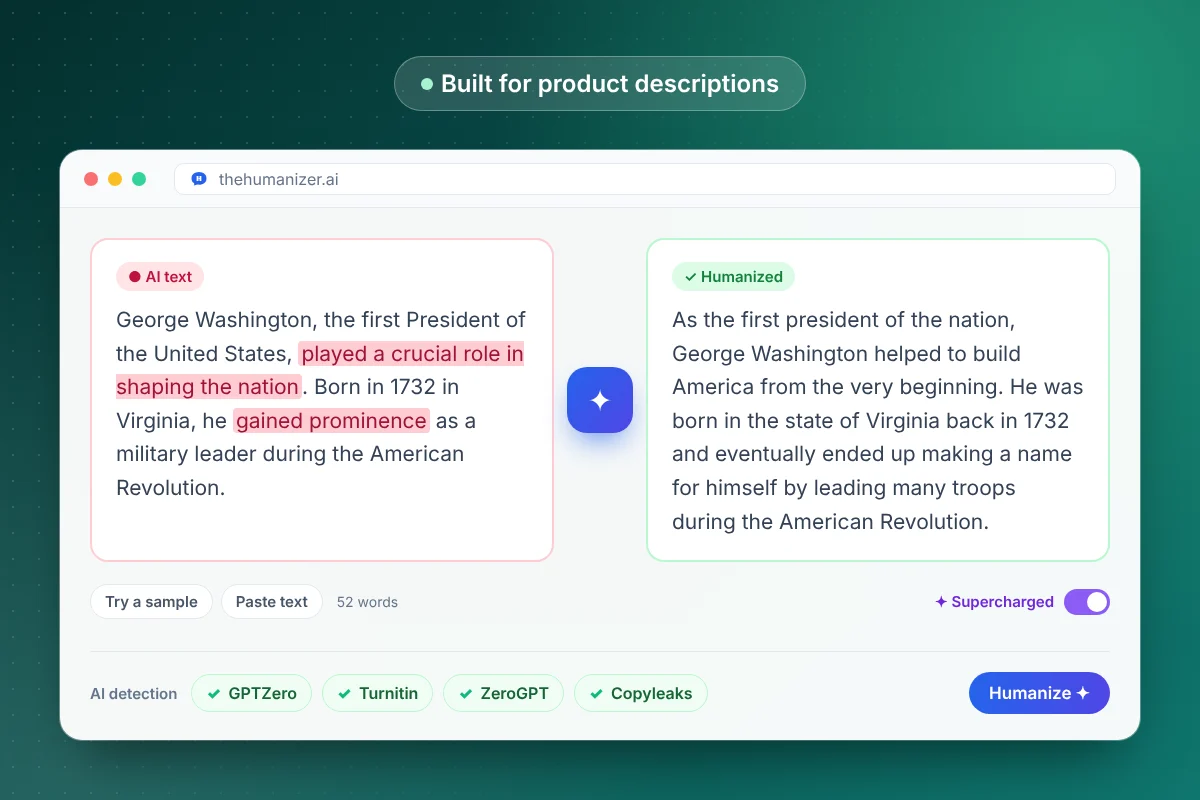
Why do AI product descriptions sound generic?
Give a model a product name and little else, and it fills the gaps with phrases that fit anything:
- Stock openers like "Introducing the perfect..." or "Say hello to your new favorite..."
- Empty adjectives: premium, stylish, high-quality, must-have
- Occasion lists ("perfect for work, travel or everyday use") that could describe any bag, mug or jacket
- The same rhythm and paragraph shape on every product
- Benefits with no proof, such as "built to last" with no material, warranty or test behind it
Our AI word checker flags stock vocabulary, and the word frequency counter shows which words you repeat most.
How do you avoid duplicate copy across similar products?
Generate twenty listings from one prompt and you often get one description twenty times with the name swapped. That doesn't help shoppers comparing variants, or give search engines a reason to show one page over another.
To keep each listing distinct:
- Lead with the difference. For a color or size variant, say what changes and keep the shared details short.
- Feed the AI one product at a time, with its own specs, materials, use case and a question customers actually ask.
- Vary the structure, not just the words. One listing opens with the problem it solves, another with how it's made.
- Check repetition across the batch. Paste several listings into the word frequency counter and rewrite phrases that appear in every one.
- Compare two listings in text compare to see how much they really differ.
Then humanize each one so the rhythm differs too.
Does Google penalize AI product descriptions?
Not for being AI-written. In its February 2023 guidance on AI-generated content, Google Search Central says: "Appropriate use of AI or automation is not against our guidelines." It also says using AI to generate content mainly to manipulate search rankings violates its spam policies.
Google's spam policies get more specific. They define scaled content abuse as "when many pages are generated for the primary purpose of manipulating search rankings and not helping users," and list "Using generative AI tools or other similar tools to generate many pages without adding value for users" as an example. The risk is thin, copycat listings, and rewording one doesn't fix it. Real product detail does. Our post on whether Google penalizes AI content covers the rest.
How do you humanize product copy without breaking the specs?
Specs are where a rewrite can do real damage. An all-cotton shirt that turns into a cotton blend, or a 12 oz mug that becomes 12 ml, is a return waiting to happen. Shopify's own help page warns that generated text "can include things such as product benefits even when you didn't list any explicitly," and that you're responsible for the accuracy of what you publish.
A safe workflow:
- Keep structured data out of the rewrite. Spec tables, size charts, model numbers, ingredients and care instructions stay as they are.
- Humanize the prose only (50 words minimum per run). Free and Basic take up to 400 words per run, and Pro and Ultimate use Supercharged mode for longer copy.
- Check every number and material against your product data. The Humanizer is designed to keep facts and key terms, but you're the one selling the product.
- Proofread before you publish, punctuation included.
Cut any claim you can't support, such as "waterproof" on a water-resistant jacket.
What does a human product description sound like?
Specific. Compare:
| AI-sounding line | More human version |
|---|---|
| Introducing our premium leather wallet, the perfect accessory for any occasion. | Full-grain leather, six card slots and a cash pocket, thin enough for a front pocket. |
| Stay hydrated in style with this must-have water bottle. | Keeps water cold through a full shift. The lid comes apart, so nothing grows in the seal. |
| Crafted with love, this candle creates a cozy atmosphere in any room. | Hand-poured soy wax with cedar and orange. We burn-test each batch before it ships. |
| Perfect for work, travel and everything in between! | Fits a 15-inch laptop and two days of clothes, and still slides under a plane seat. |
The examples are made up, and each human line only works if it's true of your product. A material, a measurement or a detail from how it's made beats any adjective. The Humanizer fixes the rhythm, and the specifics come from you.
Should you use AI for Shopify, Amazon and Etsy listings?
Many sellers do, and the platforms build it in. Shopify's admin can generate a product description from a title and a few features, and Amazon launched generative AI tools in 2023 that draft titles, bullet points and descriptions for sellers. Either way, you're responsible for what the listing says.
Follow each marketplace's listing rules and treat the AI draft as a first pass. Writing for clients or several stores? Our guide for marketers covers keeping one brand voice, and humanizing ChatGPT text covers habits to clean up first.